
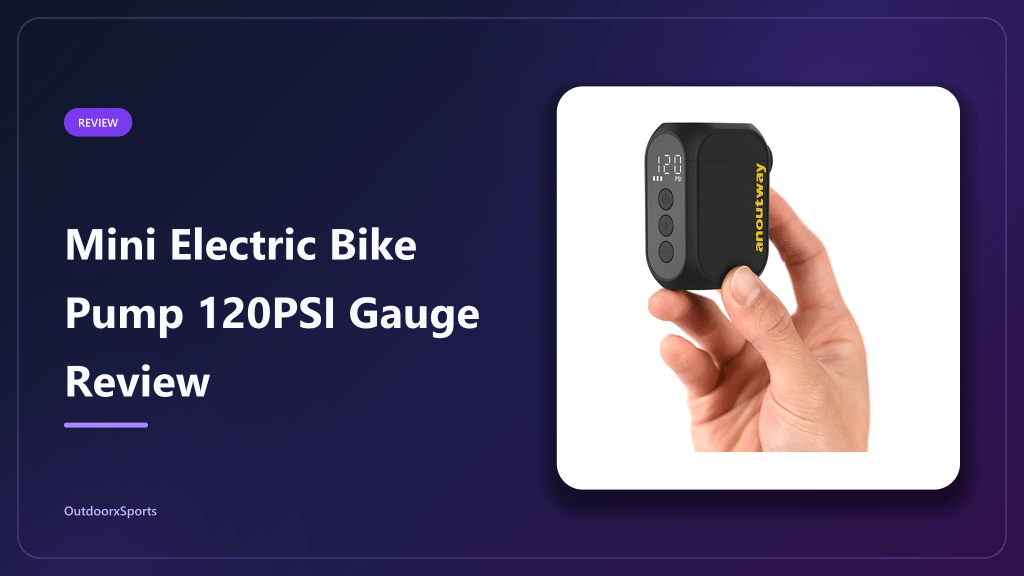
This Bike Pump Gauge Mini Electric 120PSI review covers a pocket-sized inflator built to save your arms at the roadside. The anoutway AS210 PRO is a USB-C rechargeable mini pump that claims a 120 PSI ceiling, 1 PSI pressure accuracy and automatic cut-off at your chosen target.
It’s worth buying if you want quick, repeatable pressure on road or gravel tyres without lugging a frame pump around. Skip it if your rides often start from completely flat mountain bike tyres, or if you’d rather own one pump for the workshop and the saddle bag. The cards below give the short version before we get into the detail.

1. Bike Pump Gauge Mini Electric 120PSI
Anoutway’s smallest pump is a 120 g capsule that puts air in your tyre with a motor instead of your shoulders. The listing claims a 120 PSI maximum, 1 PSI accuracy and an auto-stop cut-off, and 838 Amazon reviewers have averaged 4.4 out of 5. Here’s what the specs actually promise, how it behaves in daily use, and where it runs out of puff.
What it is
A mini electric bike pump is a battery-powered inflator that drives air with a small internal compressor instead of your body weight. The Gauge Mini Electric 120PSI, sold as the anoutway AS210 PRO, sits at the tiny end of that category: a plastic body, USB-C charging, and Presta and Schrader compatibility in a single head.
Against the established names it’s a budget-to-mid-range pick. Lezyne and Topeak both sell electronic pumps with larger bodies and bigger batteries, and Crankbrothers has its own pocket-sized options, but those generally ask more money. The anoutway competes on size and simplicity rather than raw air volume, and the listing is fairly clear about that.
Setup and first impressions
Unboxing is short. The listing names the pump as the only included component, so there’s no confirmed USB-C cable and no carry pouch, and that’s worth knowing before you order. Plan on using a cable you already own.
A full charge takes about 30 minutes according to the manufacturer, and that short window is one of the nicer details here. A 450 mAh cell is small by power bank standards, so topping the pump up before a ride becomes a habit rather than a chore.
Using it is a two-step routine. You pick your unit, PSI or bar, set the target value in 1 PSI or 0.1 bar steps, then connect the head to the valve. The appeal is what happens next: the motor runs and shuts off on its own when the target is reached. With 838 ratings averaging 4.4 out of 5, the core promise clearly holds for most buyers. The one thing to practise is the valve connection, because the body is small enough that you need a steady hand.
| Brand and model | anoutway AS210 PRO (also listed as AT1 PRO) |
| Maximum pressure | 120 PSI / 8.3 bar |
| Pressure accuracy | 1 PSI / 0.1 bar, manufacturer claim |
| Weight | 120 g (one listing bullet states 125 g) |
| Dimensions | 7 x 5.7 x 3.1 cm / 1.93 x 1.1 x 2.76 in |
| Battery and charging | 450 mAh, USB-C, about 30 minutes to full |
| Valve compatibility | Presta and Schrader |
| Auto-stop | Yes, motor cuts out at the set pressure |
| Body material and colour | Plastic, black |
| Amazon rating | 4.4 out of 5 from 838 reviews |
Day-to-day use
How fast is it in real use?
PSI is a pressure unit that measures how hard air pushes against the inside of your tyre, and it’s the number most road riders think in. The manufacturer’s headline claim is that a full 450 mAh charge inflates at least three 700x25C tyres from 0 to 120 PSI, which is a serious amount of work for something this small.
Top-ups are where it earns its place in a jersey pocket. If a tyre has softened overnight or you want to fine-tune before a fast group ride, the pump gets you to a target number in a fraction of the time a manual mini pump would take.
Volume is the real limit, not pressure. Fat tyres on something like the WEIZE 26/27.5 inch Outdoor Cycling Mountain Bike need far more air than a narrow road casing, and a pump this compact has to work harder for every one of those litres.
How long does the 450 mAh battery last?
The listing doesn’t publish a run time in minutes, so the tyre count is the number to work from. Three full road tyre fills per charge is the stated figure, and top-ups obviously stretch much further because each one takes only a few seconds of motor time.
Charging over USB-C is a genuine convenience. Most riders already carry a cable for a phone or bike computer, and 30 minutes on a laptop or power bank is easy to fit into a pre-ride routine.
The catch is discipline. There’s no published low-battery warning in the listing and no way to test the cell without riding, so the sensible habit is to plug it in after every couple of rides rather than waiting for a flat. Treat it like a light, not like a floor pump.
Is it easy to use at the roadside?
Auto-stop is a feature that lets the pump cut the motor the moment your set pressure is reached, and it’s the reason this design works. You set a target, connect the head, press go and let it run, which means no crouching over the wheel counting strokes in the rain.
Presta and Schrader are the two valve standards on modern bikes: Presta is the narrow valve common on road bikes, Schrader is the wider car-style valve. The anoutway head covers both, so a mixed household of bikes doesn’t need adapters.
The compact body is worth thinking about in use. At roughly 7 cm long, the pump sits close to the rim and spokes, so check clearance around disc rotors before you commit, and support the valve with your free hand while it runs.
Build quality and pocket size
This is a plastic-bodied pump at 120 g, and the listing makes no claims about shock or water resistance. That’s fine for a jersey pocket or a saddle bag, but it’s not a tool to leave loose in a wet pannier or a truck bed.
Size is the standout. At 7 x 5.7 x 3.1 cm it disappears into a bar bag, and the weight is close enough to a spare tube that you won’t notice the difference. Riders who’ve avoided frame pumps for years because of the bulk have a real alternative here.
Long-term durability is the open question. A 4.4 average from 838 ratings says most owners are content, but plastic housings and small batteries age in ways that a metal barrel and a rubber hose don’t. Store it dry, charge it regularly and it should behave.
- Genuinely pocketable at 120 g and about 7 cm long.
- Auto-stop cut-off at your chosen pressure, set in 1 PSI steps.
- Works with both Presta and Schrader valves without adapters.
- USB-C charging with a roughly 30 minute top-up.
- A solid 4.4 out of 5 average across 838 Amazon ratings.
- The 450 mAh battery means frequent charging between rides.
- The listing names only the pump, so no confirmed USB-C cable in the box.
- Plastic body with no published water or impact resistance rating.
- Costs more than a decent manual mini pump that never needs charging.
Who should buy it
Buy it if you…
Road and gravel riders are the obvious fit. Narrow tyres run high pressures, which is exactly what a 120 PSI pump with 1 PSI accuracy is built for, and a mid-ride top-up takes seconds rather than minutes. Anyone with hand or shoulder issues will also appreciate not fighting a manual pump on a cold morning. Commuters get the same benefit: a quick check before the ride home, no workshop trip needed.
Skip it if you…
If your rides start from flat, wide mountain bike tyres, this isn’t the tool. The 450 mAh cell is sized for top-ups and a stated three full road tyre fills, not repeated volume work on low-pressure trail rubber. Home mechanics should keep a track pump as well, and our guide to using a Panaride floor bike pump covers the basics of getting pressure right at home. Budget shoppers can also do the job manually for less.
Alternatives to consider
Topeak’s Mini Morph is the classic manual mini pump with a gauge, and it never needs charging. A CO2 inflator from Lezyne is lighter and faster again, though cartridges are single-use and you get no pressure readout. If you want to see how this pump lines up against the rest of the field, our roundup of the best electric bike pumps of 2026 covers the wider market.
Frequently asked questions
Is the anoutway mini electric bike pump any good?
Yes, for the job it’s designed for. It carries a 4.4 out of 5 average from 838 Amazon ratings, which is strong for a small accessory, and the headline features all check out against the listing: 120 PSI maximum, 1 PSI accuracy, auto-stop and both valve types. The honest caveat is that “good” here means top-ups and roadside saves, not workshop duty. Expect to charge it regularly.
Can this mini electric pump really reach 120 PSI?
The manufacturer states a 120 PSI maximum and claims a full charge will inflate at least three 700x25C tyres from 0 to 120 PSI. That’s the number to work from. Whether any individual pump hits the ceiling depends on the tyre, the valve and the charge state, and the listing’s 1 PSI accuracy figure is a manufacturer claim rather than an independently verified result.
What PSI should I actually run?
Start with the range printed on your tyre sidewall and adjust from there. Rider weight, rim width and surface all shift the sweet spot, and a wet ride often wants a little less pressure than a dry one. Because this pump sets pressure in 1 PSI or 0.1 bar steps and stops itself, it’s easy to test a change and repeat it later.
How does it compare with a manual mini pump?
A manual mini pump is lighter, cheaper, never needs charging and can’t fail because of a flat battery. This electric pump is faster and less tiring, and the auto-stop gauge means you stop guessing at pressure. The trade is battery management and a plastic body. If you puncture once a season, manual is fine. If you top up before every ride, electric earns its keep.
Is it worth it for road cyclists?
For road riders running 700x25C tyres at high pressure, yes. That’s the exact use case the manufacturer designed around, and the 120 PSI ceiling covers road pressures with headroom. It fits a jersey pocket at 120 g and tops up quickly. If you ride tubeless and rarely need air, a smaller manual pump or a CO2 setup may serve you better.
Final verdict
The Gauge Mini Electric 120PSI does one job well: it removes the effort and guesswork from topping up a road tyre. Auto-stop at 1 PSI accuracy, Presta and Schrader compatibility in one head, and a 120 g body that genuinely disappears into a pocket are a compelling combination for the money. It’s a sensible mid-range buy in 2026 for anyone who rides regularly and hates crouching over a wheel.
The drawbacks are real but predictable. A 450 mAh battery needs habitual charging, the box appears to contain the pump alone, and the plastic shell has no published water resistance rating. Treat it as a roadside companion rather than a workshop tool and it will do what you bought it for. We rate it 4.4 out of 5, with the battery the only thing stopping it going higher.
Affiliate disclosure: This article contains affiliate links. If you buy through them we may earn a commission at no extra cost to you. It does not change which products we recommend.

Welcome to outdoorxsports.com! I’m Russell, your guide to the awesome world of mountain biking. This blog is all about building a community of riders who love to share their passion for the sport. Expect inspiring stories, local trail recommendations, fun challenges, and tips for making the most of your time on two wheels.