
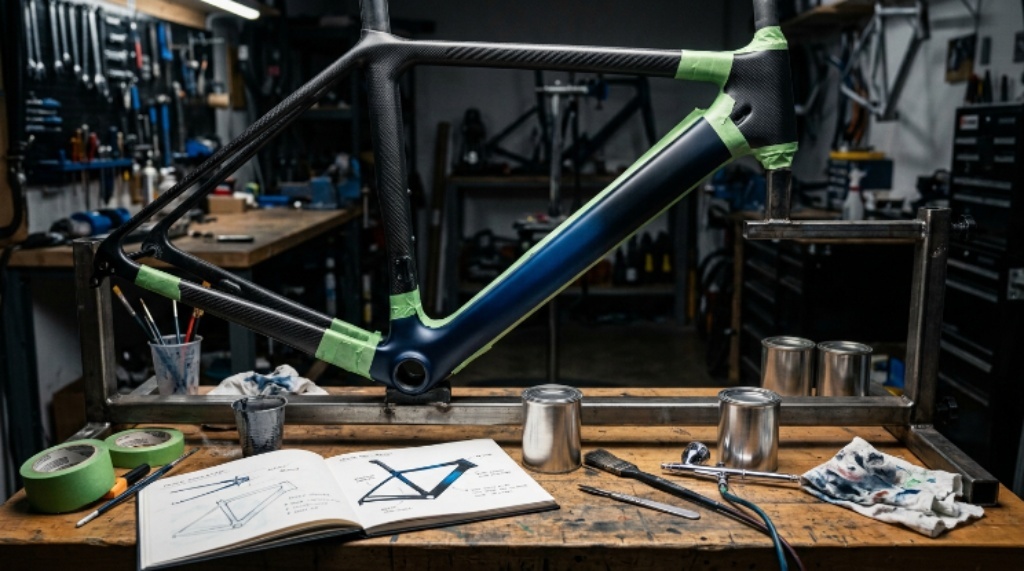
A carbon bike frame is already a statement piece. But when hundreds of bikes on the road share similar shapes, finishes, and factory graphics, a custom color or paint design can make yours feel genuinely personal.
The good news is that carbon fiber frames can be customized in far more ways than a simple color change. Depending on the manufacturer and painting process, you can choose solid colors, gradients, metallic effects, chameleon finishes, exposed-carbon looks, custom decals, logos, stripes, and even hand-painted artwork.
But there is an important catch: painting carbon fiber is not the same as painting a metal bike frame. Surface preparation matters, excessive sanding can be a problem, and custom paint can affect the terms of a manufacturer’s cosmetic or warranty coverage. A professional-looking finish should never come at the expense of the frame’s structural integrity.
This guide explains how to plan a custom carbon bike frame from the first color idea to the final finish—and what smart buyers should check before approving the design.
Key Takeaways
- Carbon bike frames can be customized with solid colors, gradients, metallics, chameleon effects, decals, logos, and hand-painted designs.
- The safest approach is professional or factory-level painting, especially for a new carbon frame.
- Never treat paintwork as a substitute for a structural inspection. Cracks, delamination, crushed fibers, or other suspected carbon damage should be evaluated before painting.
- Do not aggressively sand into the carbon laminate. Modern carbon frames rely on carefully engineered fiber orientations and resin systems, so surface preparation needs to remain controlled.
- Your choice of finish affects appearance, maintenance, and sometimes the overall cost. Chameleon, pearlescent, metallic, and intricate hand-painted finishes generally require more work than a single-color finish.
- Ask about warranty coverage before customizing. Tideace’s current warranty information excludes cosmetic treatments and paint damage, while other manufacturers may have their own rules.
- The best custom designs consider the entire bike—not just the frame. Wheels, cockpit, saddle, bottle cages, bar tape, and decals should work together.
- For a new frame, approving the design before production and painting is usually easier than repainting an existing frame later.
Why Customize a Carbon Bike Frame?
Customization is about more than making a bike look different.
For many riders, the frame is the visual centerpiece of the entire build. A thoughtful color scheme can tie together the wheels, cockpit, saddle, and accessories while giving the bike a distinctive identity.
1. Create a bike that actually feels like yours
Factory paint schemes are designed to appeal to a broad market. A custom frame doesn’t have that limitation.
You can choose a color palette that matches your personal taste, race kit, team colors, favorite car, or even a particular design concept. A restrained two-tone finish can look understated and premium, while a bright gradient or color-shifting finish can make the bike impossible to miss.
2. Build a team or brand identity
Custom frames can be particularly useful for cycling clubs, racing teams, bike shops, content creators, and brands.
Matching frame colors, logos, rider names, or graphics can create a consistent visual identity across multiple bikes. Tideace currently offers custom colors and decals, including non-standard color requests, with pricing depending on the complexity of the requested finish.
3. Preserve an exposed-carbon aesthetic
Not every custom frame needs to be colorful.
An exposed-carbon or partially exposed-carbon design can combine the technical appearance of the weave with carefully placed color, graphics, or clear-coated sections. Matte and gloss clear coats can also create noticeably different visual effects.
4. Refresh an older frame
Custom painting can give an older frame a completely different appearance. However, this is where riders need to be particularly careful.
A paint job should never be used to hide suspected structural damage.
If a frame has been crashed, heavily impacted, or shows unusual cracks, soft areas, crushed fibers, or other signs of possible carbon damage, have it inspected before any cosmetic work. Current professional carbon-painting guidance specifically recommends checking the frame’s condition before preparation and warns against allowing paintwork to conceal underlying damage.
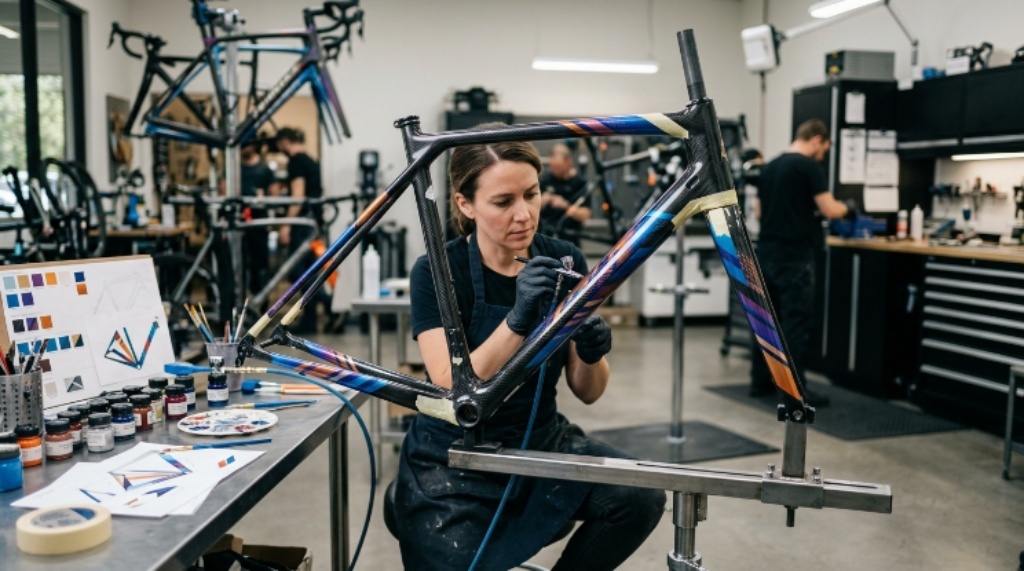
Popular Carbon Bike Frame Color and Design Options
There isn’t one “best” color. The right choice depends on the look you’re after and how much visual complexity you want.
Solid Colors
A single color is the simplest route and can produce a remarkably clean result.
Popular directions include:
- Gloss black
- Matte black
- White
- Silver
- Deep blue
- Racing red
- Forest or olive green
- Cream or off-white
- Custom brand colors
Solid colors also make it easier to coordinate the rest of the build.
Two-Tone Designs
Two-color frames offer more visual interest without becoming overly complicated.
For example:
- Black + metallic silver
- Navy + white
- Red + black
- Cream + dark green
- Raw carbon + a bright accent color
A good two-tone design usually has a clear visual hierarchy: one dominant color and one supporting accent.
Gradients and Fades
A gradient transitions between two or more colors instead of creating a hard dividing line.
This works especially well on modern carbon frames because long tubes provide enough surface area for the transition to develop naturally.
Gradients generally require more preparation and application work than a simple solid color, so they can increase the customization cost. Tideace likewise identifies gradients as more labor-intensive than single-color finishes.
Metallic and Pearlescent Finishes
Metallic paints can add depth and sparkle, while pearlescent finishes can change subtly as the light moves across the frame.
These finishes can look excellent outdoors but should be evaluated under different lighting conditions before you approve the final design. A color that looks understated indoors may appear dramatically brighter in direct sunlight.
Chameleon Paint
Chameleon or color-shifting paint changes appearance depending on viewing angle and lighting.
It’s one of the more dramatic options for a custom bike, particularly if you want a frame that looks different in photographs than it does in person.
Because the visual effect depends heavily on the paint system, application technique, and lighting, ask the painter or manufacturer for actual examples rather than relying entirely on a digital color mockup.
Custom Decals and Hand-Painted Graphics
Graphics can include:
- Rider names
- Race numbers
- Team logos
- Personal symbols
- Geometric patterns
- Stripes
- Abstract artwork
- Brand graphics
Tideace’s existing customization information specifically lists custom logos, decals, rider names, team insignias, and hand-painted details among its customization possibilities.
How to Choose the Right Color for Your Bike
Color selection sounds easy until you’re staring at dozens of nearly identical shades.
A practical approach is to start with the three-color rule:
Primary color + secondary color + accent color
For example:
Matte black + metallic gray + electric blue
The primary color covers most of the frame. The secondary color adds structure or contrast. The accent color is reserved for small details such as logos, stripes, or selected tube sections.
This keeps a complicated design from becoming visually noisy.
Also consider your existing components.
A frame might look fantastic by itself but less impressive once paired with wheels, a saddle, bar tape, cables, and bottle cages in conflicting colors.
Tideace recommends considering the relationship between the frame and wheelset, handlebars, saddle, decals, and accessories when developing a complete bike aesthetic.
Don’t Forget the Finish: Matte vs. Gloss
Color is only half of the visual equation. The surface finish can completely change how that color looks.
Gloss Finish
Gloss paint reflects more light and tends to make colors appear deeper and more saturated.
Best for:
- Metallic colors
- Bright colors
- Chameleon effects
- High-contrast graphics
The downside is that fingerprints, smudges, and some surface imperfections can be more noticeable.
Matte Finish
Matte paint creates a softer, understated appearance.
Best for:
- Black and gray
- Minimalist designs
- Stealth builds
- Exposed-carbon aesthetics
Matte surfaces generally require more care when cleaning because aggressive polishing or inappropriate products can alter the appearance of the finish.
Satin Finish
Satin sits between matte and gloss. It can be a useful choice if you want some light reflection without the highly polished appearance of full gloss.
How the Custom Carbon Frame Process Should Work
A good customization project starts long before paint is sprayed.
Step 1: Choose the Frame
Decide on the frame type first: road, gravel, mountain bike, cyclocross, triathlon, or another platform.
Confirm the correct frame size, geometry, brake standard, drivetrain compatibility, axle standard, headset requirements, and other specifications before finalizing the paint.
A beautiful paint job won’t fix an incompatible frame.
Step 2: Define Your Design Brief
Give the manufacturer or painter clear information.
Include:
- Preferred colors
- Finish type
- Design references
- Logo files
- Text or rider name
- Areas that should remain exposed carbon
- Preferred graphic placement
- Gloss, matte, or satin preference
If possible, provide high-resolution references rather than describing a color only with words.
Step 3: Request a Digital Mockup
A digital rendering gives you an opportunity to catch problems before production.
Check the design from multiple angles:
- Drive side
- Non-drive side
- Front
- Rear
- Top
- Bottom
- Fork
Pay special attention to areas where tubes meet. A graphic that looks perfect from one angle can appear awkward when it wraps around a tube.
Step 4: Approve the Exact Design
Do not assume that “blue” means the same thing to everyone.
Confirm the exact shade, finish, logo color, and graphic placement before the order moves forward.
Tideace’s current customization process describes confirming the model, color, and size first, then communicating the design, approving the final design, and receiving physical pictures before shipment.
Step 5: Professional Surface Preparation
This is one of the most important stages.
Carbon frames aren’t simply pieces of plastic that can be aggressively stripped and repainted. The surface must be prepared without compromising the composite structure.
Current carbon-frame painting guidance recommends controlled surface preparation, appropriate primer or sealer, thin paint layers, and a suitable protective clear coat. It also warns against sanding deeply into the carbon and against inappropriate high-temperature curing.
Step 6: Paint and Graphics
The painter applies the selected base colors, patterns, graphics, decals, or hand-painted elements.
More complicated designs naturally require more stages.
Step 7: Clear Coat and Final Inspection
A protective clear coat can provide the final appearance and help protect the underlying finish.
The completed frame should then be inspected for:
- Uneven coverage
- Paint runs
- Contamination
- Incorrect graphics
- Color inconsistencies
- Surface defects
- Damage around interfaces and mounting points
Before shipment, ask for clear photos of the finished frame.
The Most Important Safety Issue: Paint Should Never Compromise the Carbon
This is the part many generic bike-painting articles get wrong.
Carbon fiber frames are engineered composite structures. The fiber and resin system, laminate orientation, wall thickness, joints, and load paths all contribute to structural performance.
That means surface preparation matters.
If you’re repainting an existing frame, avoid aggressive stripping methods unless the process has been specifically approved by the manufacturer or performed by an experienced carbon specialist.
A current 2026 carbon-frame painting guide recommends scuffing the existing coating rather than unnecessarily removing material from the carbon itself. It specifically warns that deep sanding can damage the carbon structure.
If you’re uncertain whether a mark is paint damage or carbon damage, stop and have the frame assessed.
For bikes covered by an applicable bicycle safety standard, ISO 4210-2:2023 provides requirements covering the design, assembly, testing, and manufacturer instructions for common city, trekking, mountain, and racing bicycles.
Important: compliance with a bicycle standard does not mean an owner can modify a frame without consequences. Manufacturer instructions and warranty conditions still matter.
Custom Paint and Your Warranty: Check Before You Start
Warranty coverage is one of the most overlooked parts of custom frame painting.
Different manufacturers have different policies.
For example, ENVE states that custom painting an applicable frame does not void the carbon structural warranty itself, but it does void the company’s factory paint warranty. ENVE also recommends checking frame tolerances and component fit before custom paint work.
Tideace’s current warranty policy is different: it lists surface treatments and cosmetic issues among exclusions and specifically excludes paint damage, fading, and color changes from its limited warranty coverage.
So before customizing a frame, ask:
- Does repainting affect the structural warranty?
- Is the factory paint warranty still valid?
- Are decals considered cosmetic modifications?
- Does the manufacturer require an approved painter?
- Does removing factory paint affect warranty coverage?
- What documentation should you keep?
Get the answer in writing.
This is especially important for an expensive carbon frameset.
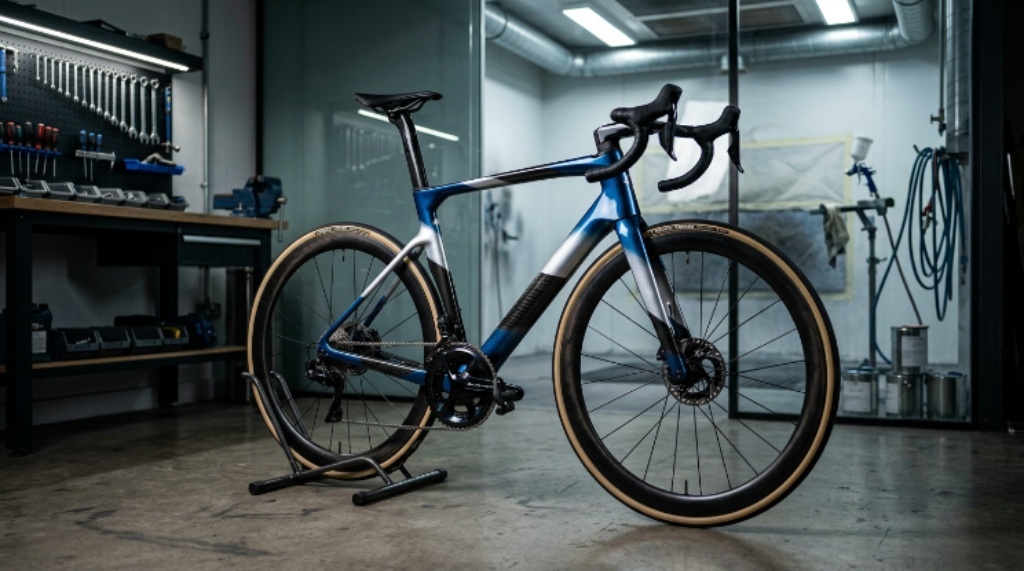
What Determines the Cost of a Custom Carbon Frame?
There is no single universal price because customization is essentially a combination of materials, labor, preparation, and design complexity.
The main cost drivers are:
| Customization | Relative complexity |
| Single-color finish | Low |
| Two-tone design | Low–medium |
| Simple stripes | Medium |
| Gradient/fade | Medium–high |
| Metallic/pearlescent | Medium–high |
| Custom decals | Medium |
| Hand-painted artwork | High |
| Chameleon/color-shifting finish | High |
| Highly detailed multi-stage graphics | Very high |
Tideace identifies paint complexity, hand-painted details, decals, material quality, protective coatings, and the overall customization process as major cost factors.
If you’re ordering directly from a manufacturer, ask whether custom paint is priced as an upgrade to the frame or quoted separately.
Tideace’s customization-color page says non-standard colors can incur additional charges and that pricing varies with the requested design and color; it also notes that more specialized finishes can cost more.
How to Care for a Custom-Painted Carbon Frame
Once your custom frame arrives, the best way to protect the finish is surprisingly simple.
Wash it regularly
Use a bicycle-safe, non-abrasive cleaner and a soft cloth or sponge.
Avoid aggressive chemicals unless the manufacturer specifically approves them.
Don’t aggressively polish a matte finish
Matte surfaces are particularly easy to alter with abrasive compounds or polishing products.
If you want to preserve the original appearance, follow the finish manufacturer’s cleaning recommendations.
Protect high-contact areas
Consider protective film in areas vulnerable to:
- Cable or hose rub
- Heel contact
- Chain slap
- Transport straps
- Bike-rack contact
- Frame-bag abrasion
Transport it carefully
A custom paint job can be ruined by careless transportation even when the frame itself remains structurally sound.
Use appropriate padding and make sure frame contact points are clean before securing the bike.
Inspect the frame periodically
Look beyond the paint.
If you notice a new crack, unusual indentation, crushed area, delamination-like appearance, or damage after a crash, don’t simply cover it with paint or a decal.
Have the frame evaluated first.
Should You Customize a New Frame or Repaint an Existing One?
For most riders, factory customization on a new frame is the simpler option.
With a new frame, the manufacturer can integrate the paint and graphics into the production process. You also avoid stripping an existing finish and potentially introducing unnecessary risk during preparation.
Repainting an existing frame makes more sense when:
- You already love the frame’s geometry and ride quality.
- The frame is outside its cosmetic warranty period.
- You want to restore an older bike.
- You have access to a reputable carbon-frame painter.
- The frame has been professionally inspected before painting.
If the frame has crash damage, structural concerns should always be resolved before cosmetic work.
A Better Way to Plan Your Custom Bike Design
Before ordering, create a simple one-page design brief.
Primary color:
Secondary color:
Accent color:
Finish:
Graphics:
Logo:
Exposed carbon:
Fork:
Wheelset:
Cockpit:
Saddle/bar tape:
Then ask the manufacturer to create a visual mockup.
This small step can prevent expensive misunderstandings.
Final Verdict: Is a Custom Carbon Bike Frame Worth It?
If aesthetics, individuality, and long-term ownership matter to you, custom paint can be one of the most satisfying upgrades you can make.
But the best custom frame isn’t necessarily the one with the most colors.
A well-designed frame has visual balance, appropriate materials, clean graphic placement, a durable finish, and careful surface preparation. It should complement the rest of the bike instead of competing with it.
For a new carbon frame, factory-level customization is generally the most straightforward route. For an existing frame, use an experienced carbon-frame painter and make sure the frame is structurally sound before any paint is removed.
And above all, treat warranty and structural safety as part of the design decision—not as an afterthought.
A custom carbon frame should look incredible when it leaves the garage, but it should also be ready for thousands of miles after the novelty wears off.
Frequently Asked Questions
Can you paint a carbon fiber bike frame?
Yes. Carbon bicycle frames can be professionally painted using appropriate surface preparation, primers or sealers, paint systems, and protective clear coats. The critical issue is avoiding preparation methods that damage the carbon laminate.
Does painting a carbon frame make it weaker?
Painting itself is not inherently a problem when performed correctly. The bigger concern is improper preparation—especially aggressive sanding or processes that damage the carbon structure. Always follow the frame manufacturer’s instructions or use an experienced carbon-frame painter.
Can I sand a carbon bike frame before painting?
You should not aggressively sand into the carbon laminate. Current professional guidance recommends preparing the existing surface carefully rather than unnecessarily removing structural material.
Does custom paint void a carbon frame warranty?
It depends on the manufacturer. Some brands distinguish between the structural warranty and the paint warranty. ENVE, for example, says custom painting can void its factory paint warranty while leaving the carbon structural warranty intact under its stated conditions.
Tideace’s current policy excludes certain cosmetic treatments and paint-related issues, so buyers should review the applicable warranty before ordering a custom finish.
What is the best finish for a carbon bike frame?
There is no universal best finish. Gloss is a strong choice for vivid, metallic, or color-shifting designs. Matte works well for understated and stealth-oriented builds. Satin provides a middle ground.
Are chameleon bike frame colors worth it?
If you want a highly distinctive appearance, chameleon paint can be worth considering. It changes visually with lighting and viewing angle, but it is generally more complex than a single-color finish and may increase the customization cost.
Can I add my name or logo to a carbon frame?
Yes, custom decals, logos, rider names, and hand-painted graphics are common customization options. Tideace currently lists custom decals and personalized graphics among its available customization services.
Should I customize the frame before or after building the bike?
For a new frame, customize it before final assembly. For an existing bike, remove the components before professional repainting. This provides better access to the frame and reduces the risk of contaminating or damaging components during the painting process.
Can paint hide carbon frame damage?
It can, which is exactly why it shouldn’t be used that way. If you suspect structural damage, have the frame inspected before repainting. A cosmetic repair should never be used to conceal a structural problem.
How do I get the best result from a custom carbon frame order?
Start with a clear design brief, provide accurate color references, request a full-frame mockup, confirm the finish and graphic placement in writing, ask about warranty implications, and request photographs of the completed frame before shipment.
For Tideace’s current custom-color process, the company says customers provide the model, color, and size, review the design after payment, confirm the design, and receive physical pictures before shipping.
Bottom line: Customizing a carbon bike frame is about more than choosing a cool color. The best results come from combining good design with professional composite-safe preparation, a suitable coating system, clear communication with the manufacturer, and a proper understanding of warranty coverage. Do that, and your frame can be distinctive without compromising the things that matter most when you actually ride it.

Welcome to outdoorxsports.com! I’m Russell, your guide to the awesome world of mountain biking. This blog is all about building a community of riders who love to share their passion for the sport. Expect inspiring stories, local trail recommendations, fun challenges, and tips for making the most of your time on two wheels.