
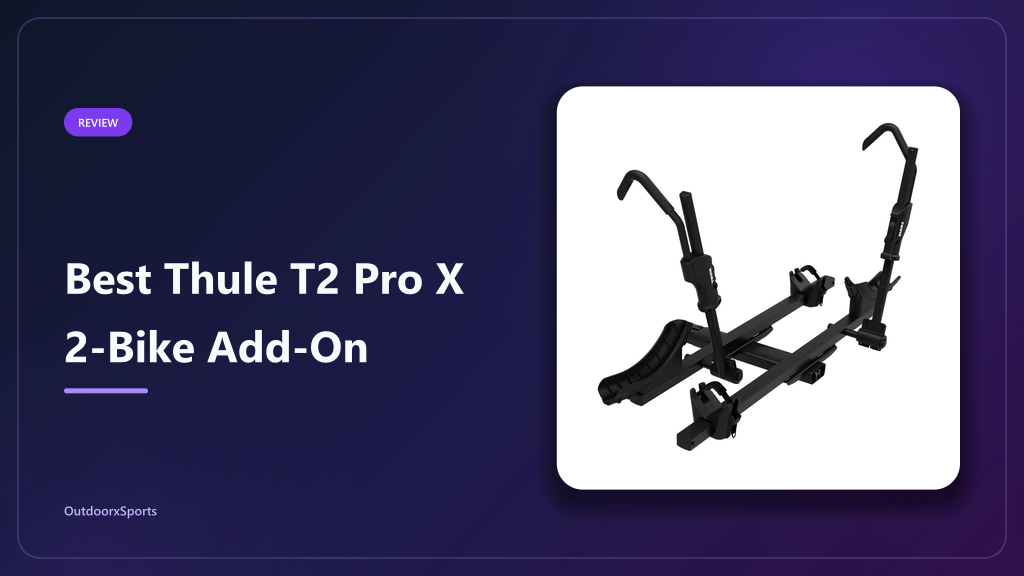
Thule T2 Pro X 2-Bike Add-On is the expansion module that turns a two bike Thule T2 Pro X platform hitch rack into a four bike carrier. Thule sells it as a bolt on accessory rather than a standalone rack, so it only makes sense if the base rack is already sitting on your car.
Buy it if you own the base rack, need two more slots and have a 2 inch hitch. Skip it if your receiver is smaller, you ride with front fenders fitted, or you’re starting from zero and want four bikes from day one. The card below shows current pricing and stock.

1. Thule T2 Pro X 2-Bike Add-On
Thule’s add-on is the practical answer for anyone who already runs the T2 Pro X and keeps running out of slots. It matches the base rack part for part, holds bikes by the front wheel and takes tires up to 3 inches. It’s also the most expensive way to add two slots, which is why it only makes sense for existing owners.
What it is
The Thule T2 Pro X 2-Bike Add-On is a bike rack expansion module, meaning it’s an accessory that bolts onto a carrier you already own rather than a rack that stands on its own. Thule designs it for the T2 Pro X platform hitch rack, and fitting it takes that base rack from two bikes to four. It ships as the add-on alone, so if the T2 Pro X isn’t already on your car, this listing won’t get you riding.
A platform hitch rack is a carrier that slides into a vehicle’s receiver and holds bikes upright on wheel trays. That layout has become the default for heavy, expensive or awkward bikes because the wheels take the load and nothing presses hard on the frame.
Frame-free is Thule’s shorthand for arms that grip the front wheel instead of clamping the frame. Two more wheel trays, two more ratcheting arms and the spine that links them to the original rack arrive in the box.
This is premium hardware in a premium bracket. Kuat, Yakima and Saris all sell add-on modules for their own flagship platform racks, while RockyMounts and 1UP USA sell four bike carriers outright. Most shoppers in 2026 end up choosing by base rack rather than by module, because an add-on only fits the family it was engineered for.
Setup and first impressions
The first thing buyers notice is the box. Thule lists the add-on at 44 pounds, and the reviews we read describe fitting it as a two person job, not because the sequence is complicated but because the spine is long, awkward and heavy above chest height.
A hitch receiver is the square socket under a rear bumper that a rack’s shank slots into. This add-on is limited to 2 inch (50 mm) receivers, the size usually found on Class III and Class IV hitches. If your car runs a 1.25 inch receiver, the conversation ends there.
Thule’s printed guide covers the bolt sequence, and the broad order of work runs like this:
- Confirm the base rack is a T2 Pro X on a 2 inch receiver, then lay the parts out and check the hardware against the list.
- Take the base rack off the car if you can. Working at waist height saves a lot of swearing.
- Attach the add-on spine to the base rack’s mounting points and tighten in the order Thule supplies.
- Refit the rack to the hitch, then look along the two tiers of trays and check the spacing.
- Load a single bike first to confirm tire and frame clearance before you commit to four.
First impressions from owner reports are mostly about solidity. The steel sections feel like they belong to the same product, the trays line up with the originals and the ratcheting arms use matching hardware.
The recurring complaint isn’t fit, it’s the price and the bulk. Because the add-on normally stays attached once it’s on, most owners treat the weight as a one time inconvenience rather than a daily one. That’s a fair trade for some riders and a deal breaker for anyone who strips the rack off between trips.
| Product type | Hitch rack expansion module (add-on only) |
| Manufacturer part number | 904650 |
| Receiver size | 2 inch (50 mm) only |
| Bikes added | 2, for 4 total with a T2 Pro X base rack |
| Wheel sizes | 20 to 29 inches |
| Maximum tire width | 3 inches, no adapters needed |
| Frame contact | None, frame-free ratcheting arm |
| Item weight | 44 pounds |
| Item dimensions | 53 x 28 x 9 inches |
| Not compatible with | Front fenders |
Day-to-day use
How stable is the rack with four bikes loaded?
Stability starts with the hitch, not the trays. Tongue weight is the downward load a hitch is rated to carry, and four bikes plus a rack pushes close to that figure on a lot of small SUVs. Check your vehicle’s rating before you assume four is fine.
The design does what it can. Thule lets you slide the mounts side to side, so you can widen the gaps between neighboring bikes instead of stacking handlebars and pedals into each other. Buyers report that this spacing adjustment is the difference between a calm drive and constant rattling.
Platform racks in general hold their shape well under load because the weight sits low and over the hitch rather than hanging off a strap. That’s the main reason riders move up from trunk racks to this style, and our look at the best hitch bike racks in Florida covers how much heat, humidity and salt air matter for long term hardware.
One habit worth copying from owners: stop after the first few miles, put a hand on each tray and check for movement. Bolts settle, and a five minute check early saves a wobble later.
Is it easy to load and unload four bikes?
Loading is the strongest part of the design. The ratcheting arm holds the front wheel, so you lift the bike by the frame, drop the wheel into the tray and push the arm down until it clicks. No straps threading through spokes, no hooks near brake lines.
Order matters more with four than with two. Load the inner positions first, because reaching past two bikes to secure a third is a shoulder workout you don’t need. Alternate the direction of neighboring bikes where the bars allow it, since that keeps wider handlebars from tangling.
The tray spacing adjuster is the tool you’ll use most. A downhill bike with 800 mm bars and a road bike with narrow drops can coexist, but you’ll probably shift the mounts once and leave them there.
Unloading at the end of a wet ride is the same job in reverse. The one catch is the fender rule: Thule states the racks are not for use with front fenders, so a commuter with mudguards needs the front wheel off or a different carrier altogether.
What does the build quality feel like?
The unit is mild steel finished in powder coat, and at 44 pounds it has the heft you’d expect from a permanent fixture rather than a weekend accessory. Thule’s hardware is generally well finished, and the arms share the same ratchet mechanism as the base rack.
Long term wear comes down to where you park. Road salt and coastal air are unkind to any steel rack, and a hose down plus a wipe at the end of winter goes a long way. If your vehicle lives outdoors, plan on an annual check of the bolts and a look at the paint where the two sections meet.
The listing doesn’t quote a corrosion warranty figure for the add-on, so confirm that with Thule if your rack sees year round weather. For most riders, the honest summary is that it feels like a lifetime part, provided you give it a wash now and then.
Where does the design cause friction?
Front fenders are the clearest limitation. Thule says the trays aren’t for use with front fenders, which rules out a lot of commuting and touring bikes without removing the wheel first.
The 2 inch receiver requirement cuts out a whole class of vehicles. If you drive a sedan or wagon with a 1.25 inch hitch, this add-on is simply not an option, and no amount of adapter shopping changes that.
Weight and stowage are the second friction point. At 44 pounds the unit is awkward to lift on and off alone, so it tends to stay put. That’s fine if you need four slots once a month, wasteful if you need them twice a year.
Finally, rear access. Check whether your base rack still tilts with the add-on fitted, since the extra length can change how far the tailgate swings before it meets a tray.
- Turns an existing T2 Pro X into a four bike rack without buying a second carrier.
- The frame-free arm suits carbon frames, downhill bikes and ebikes alike.
- Fits 20 to 29 inch wheels and tires up to 3 inches with no adapters.
- Side to side mount adjustment creates usable space between neighboring bikes.
- Matching Thule hardware means one brand, one setup and one set of tools.
- Requires a 2 inch (50 mm) receiver, so 1.25 inch hitches are excluded.
- Not for use with front fenders, per the manufacturer.
- 44 pounds makes it a two person or two trip job to fit and remove.
- Premium pricing for what is, in effect, two extra trays and a spine.
Who should buy it
Buy it if you…
This is a family and group rider product first. If you already own the T2 Pro X because two bikes covered most weekends, and the kids have now grown into their own bikes, the add-on is the least disruptive way to add capacity. Nothing else on the car changes, the hitch stays where it is and the loading routine stays familiar.
It also suits riders with a mixed fleet. Thule lists the trays as suitable for carbon frames, mountain bikes, downhill bikes, ebikes and fat bikes, and the 20 to 29 inch wheel range covers everything from a kids’ 20 inch build to a 29er. The 3 inch tire clearance means a fat bike rolls on without adapters, which is more than a lot of carriers manage.
Finally, it suits anyone who values one system. Two racks on one car means two sets of keys, two sets of hardware and two things to check before a trip. Keeping it all Thule is worth something, even if the price per slot is higher.
Skip it if you…
Skip it if the numbers don’t line up. A 1.25 inch receiver rules this out completely, and so does a base rack from a different family. Fenders on the front wheel rule it out for a lot of commuters too.
Skip it as well if you don’t own the base rack. Buying a T2 Pro X plus this add-on is a serious outlay, and at that point a dedicated four bike platform rack from another brand deserves a look. If you want occasional capacity for two bikes rather than four, a strap based carrier such as the Saris Bones EX 2-bike rack does a different job for far less money.
And skip it if you strip the rack off the car between trips. At 44 pounds, this isn’t a part you’ll want to fit and remove every other weekend.
Alternatives to consider
Two named rivals are worth putting on your shortlist. The Kuat NV 2.0 uses a similar platform layout and accepts Kuat’s own add-on module, so if you haven’t bought a base rack yet, it’s a direct comparison. The Yakima HoldUp Evo with the Plus add-on is the other obvious path, and it’s the one to weigh if your local dealer stocks Yakima rather than Thule.
If you’d rather start over with a four bike carrier, a dedicated rack removes the two stage purchase. Our roundup of the best bike racks for RV, Jeep Wrangler, truck and SUV use is a sensible place to see how those setups differ.
For a budget second rack instead of an add-on, the Allen Sports Deluxe 2-bike rack review shows what the entry level actually gets you.
Frequently asked questions
Does the Thule T2 Pro X 2-Bike Add-On fit my existing rack?
Only if your existing rack is a Thule T2 Pro X platform hitch rack mounted on a 2 inch (50 mm) receiver. Thule builds the add-on as a direct extension of that rack, so the mounting points, tray spacing and arm hardware all line up. It won’t bolt to a T2 Classic, an earlier T2 Pro generation, a roof bar carrier or a trunk rack, and the receiver size alone rules out most small cars.
Check the model name stamped on the rack’s spine and measure the receiver opening before you order. If you’re unsure, Thule’s fit guide and customer service can confirm it from your vehicle details. Buying the wrong module is an expensive mistake, and returns on a 44 pound box are nobody’s idea of fun.
Can the add-on carry electric bikes?
Thule lists ebikes among the bike types the trays suit, alongside mountain, downhill, fat and carbon framed bikes, and the frame-free arm is the reason. Gripping the front wheel means the motor and battery weight never presses on thin frame tubes.
The bigger question is your hitch, not your rack. An ebike can weigh two or three times what a road bike does, and four slots filled with two ebikes and two mountain bikes adds up fast. Look up your vehicle’s tongue weight rating and the combined weight of the bikes you plan to carry, then leave a margin. If that number looks tight, a lighter two bike setup may be the wiser call.
How much weight can the Thule T2 Pro X 2-Bike Add-On hold?
The Amazon listing we checked doesn’t publish a per bike or total carrying figure, and the 44 pounds it does quote is the weight of the add-on itself. That’s the number you’ll lift when fitting it, not the number it can carry.
Thule’s own documentation for the T2 Pro X base rack is the place to confirm total capacity, because the add-on’s limit is tied to the rack it’s bolted to. Your vehicle’s hitch rating sets the other ceiling. Do the arithmetic with the actual bikes you plan to carry rather than a best guess, and remember that two ebikes can use up most of a modest hitch rating on their own.
Is the add-on easy to install and remove?
Installation is straightforward but physical. The bolt sequence is a couple of steps, the parts are clearly labeled and no specialist tools beyond standard hand tools are needed. The complication is the 44 pound spine, which is long enough to be awkward and heavy enough that a second pair of hands makes the job much easier.
Removal is the same job backwards, which is why most owners leave it attached once fitted. If you need the slots only a few times a year, plan for storage space in a garage or shed and accept that fitting it is a project rather than a two minute swap. Leaving it on permanently is the path of least resistance, provided you’re happy with the extra length out back.
What do customers say about it?
When we checked the listing, it showed 3.4 out of 5 from 4 reviews. That’s a very small sample, so treat the average as a signal rather than a verdict. A rating in the low threes on a premium product usually points to expectations not quite meeting the price.
The pattern across the reviews we read was consistent with that: buyers like how it pairs with the base rack and how quickly bikes go on, then push back on cost and on the size of the thing when it’s off the car. Nothing in the feedback suggests a structural problem. It reads more like a product that does its job well and is priced accordingly.
Is the Thule T2 Pro X 2-Bike Add-On worth the price?
For an existing T2 Pro X owner who regularly carries three or four bikes, the Pro X 2-Bike Add-On is normally the cheaper route, because it avoids a second rack, a second hitch setup and a second loading routine. You’re paying for integration, not for extra metal.
For everyone else the maths is harder. If you don’t own the base rack, or you need four slots twice a year, a standalone four bike carrier or a paid loaner from a local shop makes more sense. Think about cost per trip: a mid-range module spread over five years of monthly use looks very different from the same money spent for two camping weekends a year.
Final verdict
The Thule T2 Pro X 2-Bike Add-On does exactly what Thule says it does, and it does it with the solidity you’d expect from premium brand hardware. The frame-free arm is genuinely useful for carbon and electric bikes, the 20 to 29 inch wheel range with 3 inch tire clearance covers almost any modern bike, and the side to side adjustability means four bikes can coexist without a fight.
The drawbacks are real and specific. It only works on a 2 inch receiver and only on the T2 Pro X base rack. Thule rules out front fenders. At 44 pounds it’s a fixture rather than a portable part, and it’s priced like the premium accessory it is. The 3.4 out of 5 from 4 reviews is too thin a sample to prove much, though it fits the profile of a good product that some buyers felt was expensive.
Our rating: 3.4 out of 5 stars. Buy it if you already run the T2 Pro X and want four slots with matching hardware. Skip it if you’re starting from scratch, running a smaller receiver or carrying fendered bikes, because in 2026 there are easier routes to four bike capacity.
Affiliate disclosure: This article contains affiliate links. If you buy through them we may earn a commission at no extra cost to you. It does not change which products we recommend.
Welcome to outdoorxsports.com! I’m Russell, your guide to the awesome world of mountain biking. This blog is all about building a community of riders who love to share their passion for the sport. Expect inspiring stories, local trail recommendations, fun challenges, and tips for making the most of your time on two wheels.