
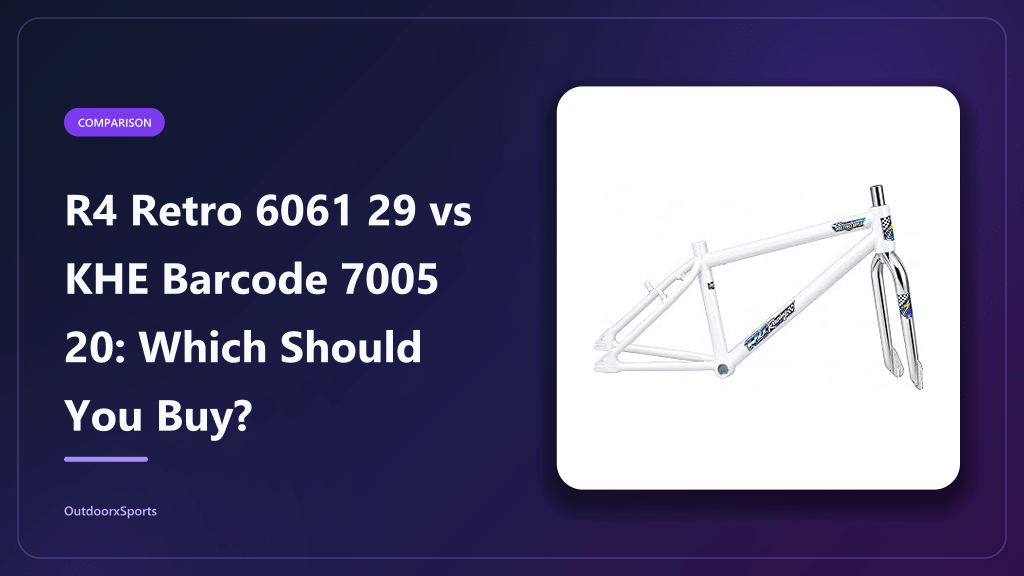
Choosing between the R4 Retro 6061 Aluminum 29″ Pro vs KHE BMX Frame Barcode 7005 Aluminium comes down to one question: do you want a big wheel retro cruiser or a featherweight 20 inch race frame? Both are aluminum, both are sold as frames, and both sit in very different corners of the market.
The short answer: R4 Retro 6061 Aluminum 29″ Pro suits riders who want a 29 inch cruiser build with a chrome fork already in the box, while KHE BMX Frame Barcode 7005 Aluminium suits pump track, park and race riders who want a 20 inch frame listed at just over 3 lbs. The cards below hold the current listing details, then we get into geometry, weight and value.


| Product | Details | Rating | Buy |
|---|---|---|---|
|
Editor’s Choice
|
R4 Retro 6061 Aluminum 29" Pro |
★★★★★
5/5
|
Check on Amazon |
|
Top Pick
|
KHE BMX Frame Barcode 7005 Aluminium |
★★★★★
5/5
|
Check on Amazon |
At a glance
The R4 frame is a 29 inch aluminum cruiser platform with a retro looptail rear end and a chrome fork included in the box. It reads as a build for paths, light dirt and general cruising with BMX styling. The KHE Barcode takes the opposite approach: a 20 inch race and park frame with published numbers (19.5 inch top tube, 75 degree head tube, 346 mm chainstays) and a claimed 3.06 lb weight. One sells a look and a wheel size, the other sells geometry a racer can compare. As of 2026 both are frame only purchases, so both need parts before either rolls.
| Spec | R4 Retro 6061 Aluminum 29" Pro | KHE BMX Frame Barcode 7005 Aluminium |
|---|---|---|
| Frame material | 6061 aluminum | 7005 aluminum |
| Wheel size | 29 inch | 20 inch |
| Fork | Chrome fork included | Not included |
| Finish | White | Matte black |
| Stated frame weight | Not listed | 3.06 lbs (3.016 lbs in the bullets) |
| Top tube length | Not listed | 495 mm (19.5 inch) |
| Head tube angle | Not listed | 75 degrees |
| Bottom bracket | Not listed | US BB |
| Rear dropouts | Not listed | 14 mm (10 mm with B-003 adapter, sold separately) |
| Amazon rating | 5/5 from 4 ratings | 5/5 from 2 ratings |
R4 Retro 6061 Aluminum 29″ Pro: strengths and weaknesses
1. R4 Retro 6061 Aluminum 29" Pro
The R4 Retro is the bigger, more nostalgic option of the two: a white 6061 aluminum frame with a looptail rear end and a chrome fork in the box. The listing positions it as a 29 inch Pro model, which points at cruiser comfort and retro looks rather than competitive 20 inch racing. It’s the frame you pick when the finished bike should look like a beach cruiser that wandered onto a dirt track.
Where it shines
- The fork comes with it. The listing title is “BMX Frame & Chrome Fork”, so the R4 lands with a matching chrome fork. That removes the fiddliest part of any frame build, because steerer length, axle standard and brake mounts all have to line up.
- 6061 aluminum is a sound choice for the money. 6061 aluminum is a heat treatable alloy that blends magnesium and silicon for a workable mix of strength, weldability and corrosion resistance. It’s the same material family used on plenty of hardtail and cruiser frames, and it won’t rust the way steel does.
- 29 inch wheels carry speed. A 29 inch wheel is a bicycle wheel with a 622 mm bead seat diameter that rolls over rough ground and holds momentum better than a 20 inch wheel. Adults who want the BMX stance without the twitch get the benefit here.
- The retro details are the product. A looptail is a rear end where the stays curve around the tire and rejoin behind it, a shape borrowed from 1980s cruiser frames. Add the white paint and chrome fork and the finished bike looks deliberate rather than assembled.
- Feedback is positive, if thin. The listing shows a 5 out of 5 average from 4 ratings. Four ratings is a small sample, so treat it as encouragement rather than proof of long term durability.
Where it falls short
- The spec sheet is thin. The listing doesn’t state frame weight, top tube length, head tube angle, bottom bracket standard or dropout spacing. Those are exactly the numbers that decide whether a frame fits you and whether your parts will bolt on.
- Big wheels limit trick riding. A 29 inch cruiser is awkward for barspins, tailwhips and tight park lines, and 29 inch tires, rims and tubes cost more and take up more space than 20 inch equivalents.
- It’s a frame, not a bike. You’ll still need a headset, bottom bracket, cranks, wheels, bars, stem, brakes, saddle and pedals. Swapping pedals is a five minute job (here’s how), the rest of the build is a weekend.
- Storage gets awkward. A 29 inch cruiser eats more shed space than a 20 inch BMX. If it lives outdoors, a bicycle cover keeps the white paint and chrome from taking the brunt of the weather.
KHE BMX Frame Barcode 7005 Aluminium: strengths and weaknesses
2. KHE BMX Frame Barcode 7005 Aluminium
The Barcode is the opposite of a cruiser. KHE lists a 20 inch frame in 7005 aluminum at 3.06 lbs, with a 495 mm top tube, 346 mm chainstays and a 75 degree head tube, and points it at pump tracks, parks and BMX racing. KHEbikes has been building BMX parts since 1988, and this frame is aimed at riders who compare numbers before they spend.
Where it shines
- The weight is published and low. KHE quotes 3.06 lbs in the description and 3.016 lbs in the feature bullets, so call it just over 3 lbs. That’s a race friendly figure for a 20 inch frame, and it’s the number that matters when you’re pumping a track or pulling the front end up.
- The geometry is all there. Top tube 495 mm (19.5 inch), chainstays 346 mm, head tube 75 degrees, seat tube 71 degrees. Top tube length is the horizontal distance between the head tube and seat tube, and it decides how roomy the frame feels; head tube angle is measured against the ground and a steeper number sharpens the steering.
- Standards are spelled out. US BB shell, 14 mm dropouts, Affix ready, headset spec Affix Art.M390209. A dropout is the slot at the rear where the axle sits, and its width has to match your hub axle, so knowing it’s 14 mm saves a return label.
- It’s aimed at three disciplines. KHE lists pump track, park and BMX racing. A pump track is a loop of rolling berms riders work with body weight instead of pedalling, and a light 20 inch frame with a 75 degree head tube is built for exactly that.
- There’s real BMX history behind it. KHEbikes was founded in 1988 by brothers Thomas and Wolfgang, and the listing carries a 5 out of 5 average from 2 ratings. Two ratings is a very thin sample, so don’t read too much into it.
Where it falls short
- The headset and axle adapter cost extra. The Affix headset isn’t included, and 10 mm axles need the Art. B-003 adapter, which isn’t included either. Put both on the parts list before you order.
- US BB narrows your crank options. A US BB is an older American bottom bracket standard that uses larger bearing cups than a mid BB, so bearings and cranks made for it are a smaller pool.
- The listing contradicts itself in places. Weight appears as both 3.016 lbs and 3.06 lbs, and one description line calls the material 7500 aluminum while the title and bullets say 7005. Worth confirming with the seller.
- The top tube is compact. At 19.5 inches it sits toward the shorter end of BMX sizing, so taller riders should compare reach against a bike they already ride. If you’re sizing a complete instead, this 4130 chromoly option is a useful reference point.
- Stock is thin. The listing showed only 12 left when we checked, in matte black only, and it’s a bare frame with nothing bolted on.
Head-to-head
What comes in the box, and what it costs to finish
The R4 isn’t the cheaper frame on the page, but it’s the more complete starting point. Because the chrome fork is part of the package, you skip the part of a build where steerer length, axle standard and brake mounts have to align, and each of those is an expensive thing to get wrong.
The Barcode is a bare frame with a documented list of extras that are not included: the Affix headset and the 10 mm axle adapter. Add forks, bottom bracket, cranks, wheels, bars, stem, seat and pedals to both builds and the amount left to buy is noticeably longer on the KHE side.
The counter argument is that a fork you choose yourself will beat a bundled one, and for a racer that’s usually true. For a first or second build, an included fork is worth more than the freedom to pick. Neither frame is a complete bike, so both need a real parts budget, whichever way you go.
Weight and agility
KHE publishes the number that matters most to a BMX rider: 3.06 lbs, or 3.016 lbs depending on which line of the listing you read. Either way it’s just over 3 lbs, which is light for a 20 inch frame and explains why the brand pushes it at pump track and racing.
The R4 listing doesn’t publish a frame weight at all. A 29 inch aluminum cruiser frame will almost certainly weigh more than a 20 inch race frame simply because there’s more material in it, plus bigger rims, tires and tubes, but we can’t quote a figure because none is given.
Weight matters most when you’re lifting the bike, spinning it, or accelerating out of a berm. A lighter frame is easier to hop and easier to throw around, which is why 20 inch BMX frames are built thin. A heavier 29 inch cruiser is more stable at speed and less tiring to pedal in a straight line, which is a different kind of useful.
Geometry and fit transparency
This round isn’t close. The Barcode lists top tube at 495 mm, chainstays at 346 mm, head tube at 75 degrees, seat tube at 71 degrees, a US BB shell and 14 mm dropouts. A rider with an existing bike can hold those numbers up against it and know roughly how the finished build will handle and fit.
The R4 gives you a wheel size, a material, a colour and a model name with “Pro” in it. There’s no top tube length, no chainstay length, no head angle, no bottom bracket standard and no dropout spacing. You’re buying a look and a concept.
For a tall rider or anyone who’s been burned by a frame that felt cramped, published geometry is worth paying for. For a rider who just wants a cruiser shape in white with a chrome fork, the missing numbers may not matter at all. It depends how much risk you want to carry on fit.
Wheel size and ride feel
Twenty inches versus twenty nine inches is the whole personality of each frame. Small wheels spin up fast, turn sharply and suit skateparks, dirt jumps and technical lines. Big wheels roll smoothly, hold speed on rough surfaces and make a bike feel less nervous under an adult rider.
The Barcode’s 20 inch platform is the right tool for gates, bowls and pump tracks. The R4’s 29 inch platform is the right tool for towpaths, fire roads, gentle dirt jumps and the kind of riding where you cover a few miles and still want the bike to look like a BMX.
If you ride mostly inside a skatepark, the KHE wins by default because a 29 inch cruiser doesn’t belong there. If your riding is mixed surfaces and longer distances with a retro flavour, the R4 does things the Barcode simply can’t. That’s the clearest split in this comparison.
Build compatibility and parts sourcing
Both frames ask you to think before you click buy, but the problems are different shapes. The Barcode documents its standards, which is genuinely helpful, then immediately narrows your options: a US BB shell limits crank and bearing choice, 14 mm dropouts need a 14 mm hub or the B-003 adapter for 10 mm axles, and the Affix headset is a specific part you have to track down.
The R4 documents almost nothing, which is the reverse problem. What it does give you is the fork, and the fork is usually the hardest single part to match, since steerer length and axle standard both have to be right. After that you’re guessing at bottom bracket and dropout specs.
Neither listing is a clean win. The R4 removes one big compatibility question, while the KHE answers several smaller ones in writing. For a buyer building up from scratch, the included fork saves a phone call and probably a return.
Durability and long term ownership
Aluminum doesn’t rust, so both frames have a head start on any steel build kept outdoors or near the coast. Both rely on paint for protection, and both will show scratches: matte black hides scuffs better than white, but a white frame makes cracks and dents easier to spot during a weekly check.
7005 aluminum is a heat treatable alloy that uses zinc as its main alloying element and is often picked when a builder wants stiffness at a low weight. 6061 aluminum is more forgiving to weld and easier to repair, which is a small point in the R4’s favour if the frame ever takes a hit.
The Barcode’s US BB and 14 mm dropouts are proven standards, and replacement bearings are easy to find. The R4’s unknowns cut the other way: if a part fails, you’re measuring rather than ordering. On balance, neither has a durability story strong enough to separate them.
Which one should you buy?
Pick R4 Retro 6061 Aluminum 29″ Pro if you…
Choose the R4 if you want a cruiser style build and you’d rather not hunt down a fork. The chrome fork in the box removes the single most fiddly compatibility question, and the 29 inch platform suits paths, fire roads and gentle dirt rather than skatepark laps. It’s also the better pick if looks matter as much as numbers: the looptail rear end and white paint make a finished bike that photographs well. Just accept that you’ll be measuring parts yourself, because the listing keeps quiet on weight, geometry and bottom bracket standard. Read the frame over carefully when it arrives and check the head tube welds and dropout alignment before you start bolting parts on.
Pick KHE BMX Frame Barcode 7005 Aluminium if you…
Choose the Barcode if you’re building a 20 inch bike for pump tracks, parks or racing and you want to know what you’re buying. The published geometry lets you compare against a bike you already ride, and the 3.06 lb figure is the sort of number that shows up in race build conversations. Budget for a headset and, if your hubs run 10 mm axles, the B-003 adapter. The 19.5 inch top tube suits younger or more compact riders best, so taller riders should check reach first. If the idea of sourcing a US BB crankset sounds annoying, factor that in too.
Other options
If neither frame fits, the sensible alternatives are a complete BMX bike in 4130 chromoly, which is tougher and heavier but far cheaper than a frame up build, or a 24 inch cruiser frame if 29 inches feels too big. A complete bike also means no compatibility guessing, which matters more than most buyers expect on a first build. Riders who mainly want a mountain bike should be looking at a different category entirely, not a BMX frame with big wheels bolted on.
| You want a fork included in the purchase | R4 Retro 6061 Aluminum 29″ Pro |
| You’re building a 20 inch pump track or race bike | KHE BMX Frame Barcode 7005 Aluminium |
| You need published geometry before ordering | KHE BMX Frame Barcode 7005 Aluminium |
| You want a retro cruiser for paths and light dirt | R4 Retro 6061 Aluminum 29″ Pro |
| You want the lower cost frame to start a build | KHE BMX Frame Barcode 7005 Aluminium |
Frequently asked questions
Is 6061 or 7005 aluminum better for a BMX frame?
Neither is strictly better, they behave differently. 6061 aluminum is a heat treatable alloy that blends magnesium and silicon for strength, weldability and corrosion resistance, and it’s easier to repair if a weld ever fails. 7005 aluminum is a heat treatable alloy that uses zinc as its main alloying element, and builders often pick it when they want stiffness at a low weight. In practice, tube shaping and wall thickness change how a frame rides far more than the alloy number stamped on the box. The R4 uses 6061, the Barcode uses 7005, and both are aluminum, so neither will rust.
Can a 29 inch frame be used for BMX style riding?
Yes, but think of it as cruiser riding rather than freestyle. A 29 inch wheel measures 622 mm at the bead seat, which makes it fast and stable on rough surfaces but clumsy for barspins, tailwhips and tight park lines. The R4 frame with its looptail rear end is built for that cruiser role: paths, dirt roads, gentle jumps and posing outside a cafe. If your riding involves skatepark coping or technical trick combinations, a 20 inch frame like the KHE Barcode makes far more sense.
Do I need a complete bike or just a frame?
Both products here are frames, so both need parts. A complete bike arrives ready to ride and is usually the cheaper route for a beginner. A frame build lets you choose every component, which is rewarding but adds up fast: headset, bottom bracket, cranks, wheels, tires, bars, stem, grips, brakes, saddle, seat post and pedals all come separately. If a build sounds like a project you’ll enjoy, a frame is fine. If you want to ride next weekend, buy a complete.
Which frame is better for a beginner?
It depends on the beginner. If they want to cruise and look good doing it, the R4’s included fork removes a genuine roadblock and the 29 inch platform is forgiving to ride. If they want to learn park and race skills, the KHE Barcode’s published geometry and 3.06 lb frame are a better learning platform, but the build is more technical because of the US BB, the 14 mm dropouts and the separate headset. A complete bike in 4130 chromoly remains the lowest stress starting point for most new riders.
What parts do I need to finish the KHE Barcode build?
Plan for a fork, an Affix Art.M390209 headset or a compatible equivalent, a US BB bearing set, a US BB crankset, a chain, 20 inch wheels with 14 mm axles (or 10 mm hubs plus the B-003 adapter), tires, tubes, bars, stem, grips, a seat and post, pedals and brakes. The frame is Affix ready if you want a rotor setup. It’s a full build rather than a quick assembly, so budget both money and a weekend. Confirm each part against the 495 mm top tube, 346 mm chainstay and 14 mm dropout spec before ordering.
Are 29 inch BMX frames suitable for adults?
Yes, that’s largely the point. A 29 inch cruiser gives adults the BMX silhouette without the cramped cockpit of a 20 inch frame, and the bigger wheels smooth out rough pavement and gravel. The trade off is weight and bulk: a 29 inch cruiser is harder to store, harder to lift into a car and much less playful on jumps. For adults who want a fun, retro flavoured bike for paths and short trips, it works well. For adults chasing tricks, a 20 inch frame remains the right answer.
Final verdict
On overall value, the R4 Retro 6061 Aluminum 29″ Pro edges it. The chrome fork in the box removes the hardest compatibility question in any build, the 29 inch platform suits the riding most buyers actually do, and the looptail frame with white paint looks like a finished idea rather than a parts list. The silence on geometry is a real weakness, so measure carefully and don’t expect a race bike. Rating: 4.5/5.
The KHE BMX Frame Barcode 7005 Aluminium is the better engineered purchase on paper. Published geometry, a 3.06 lb claimed weight and documented standards make it easy to plan a build, and KHE’s pump track and racing focus is clear. The US BB shell, the separate headset and the 14 mm dropouts narrow your parts choices, and the listing’s weight and material contradictions are untidy. For a dedicated park or race build, it’s the sharper tool. Rating: 4/5.
Buy the R4 for a cruiser you’ll actually ride everywhere. Buy the Barcode if you’re building a 20 inch bike with intent.
Affiliate disclosure: This article contains affiliate links. If you buy through them we may earn a commission at no extra cost to you. It does not change which products we recommend.

Taylor is an outdoors & sports equipment specialist, sports author, bike traveler, bicycling and skating expert, and smoke-free ride activist. He is also a regular reviewer of outdoor sports gadgets and accessories. About safety gear and biking facts he analyzes and gives his feedback to outdoorxsports. Writes and tests to help him, you, and us.