
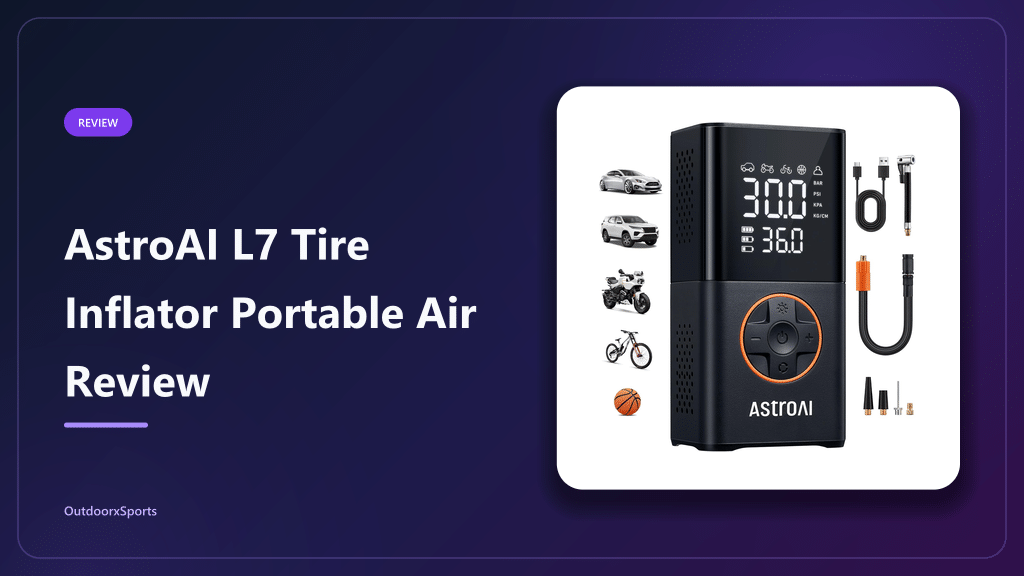
This AstroAI L7 Tire Inflator Portable Air review looks at a cordless pump that has climbed near the top of Amazon’s Automotive charts, where it holds a 4.3 out of 5 rating across 21,030 reviews. It’s a small, battery-powered compressor built for drivers who want to top up a tire without hunting for a gas station.
The short version: it’s worth it if you want an inflator under a pound with a digital gauge and automatic shut-off for car and bike tires. Skip it if you’re regularly filling large truck tires or need a compressor that runs for long stretches. Here’s how it holds up in practice.

1. AstroAI L7 Tire Inflator Portable Air
The L7 sits in the middle of AstroAI’s inflator range, alongside the L10 Mini, the L4 and the L7 Air H2 Pro. Here’s what the listing claims, what owners consistently report, and the parts that might annoy you.
Two other AstroAI inflators come up often in that range, and if you’re weighing them the AstroAI Tire Inflator 150PSI Portable Air review covers the palm-sized L10 Mini with its five presets and roughly 70 second car tire fill. It’s the closer rival if pocketability matters more to you than battery power.
What it is
Any honest AstroAI L7 review has to start with the basics: this is a cordless, battery-powered tire inflator, the sort of thing that lives in a trunk rather than a garage. It draws on a built-in 4000mAh battery instead of a 12V socket, so there’s no cord to drag around the footwell.
PSI is pounds per square inch, the pressure unit most US drivers use, and the L7 tops out at 150 PSI. AstroAI sits in a crowded budget field alongside Viair, Ryobi and DeWalt, and this model is the mainstream pick rather than the cheapest or the most powerful. The spec sheet leans on the display and the automatic shut-off more than raw speed. It also ranks among the best affordable portable tire inflators we’ve rounded up.
Setup and first impressions
Buyers consistently describe the L7 as smaller than they expected, and for a trunk-stored tool that’s a compliment. At 15.36 ounces it drops into a glovebox or a bike bag without complaint. The first job is a full charge, and owners report the battery takes a few hours to top up from empty.
The display is the part people mention most. AstroAI’s TrueGauge sensor samples pressure 200 times per second, and the screen shows your current reading next to your target. Cycling through the four presets (car, motorcycle, bicycle, ball) plus the custom mode takes a few presses, and you can switch between PSI, Bar, kPa and kg/cm².
In the box you get two air nozzles, a needle valve adapter and a Presta to Schrader adapter. A Presta valve is the narrow valve found on most road bikes, and the adapter lets the L7 clamp onto one. A few reviewers note the manual is thin and the buttons need a firm press to register.
| Brand | AstroAI |
| Model number | ACACL7BK-CA |
| Maximum pressure | 150 PSI |
| Battery | 4000mAh built in |
| Weight | 15.36 ounces |
| Capacity | 35 liters |
| Modes | Car, motorcycle, bicycle, ball, plus custom |
| Pressure units | PSI, Bar, kPa, kg/cm² |
| Included parts | 2 air nozzles, needle valve adapter, Presta to Schrader adapter |
| Warranty | 2 year manufacturer |
Day-to-day use
Inflation speed and accuracy
Speed is where the L7 shows its budget roots. AstroAI rates the battery for up to eight car tires, sized 195/65R15, taken from 30 to 36 PSI on a single full charge. That’s a top-up figure rather than a from-empty figure, and buyers report that filling a properly flat tire takes noticeably longer. Across the reviews we read, most drivers top up four tires in one sitting without needing a recharge.
Accuracy is better than the price suggests. The TrueGauge reading landed within about a pound of a separate handheld gauge in the owner reports we saw, though no inflator at this level is a calibration instrument. If you’re setting pressures for track days or a bike with tight tolerances, check with a dedicated gauge afterwards.
How does the automatic shut-off work?
Auto shut-off is a feature that stops the pump once your chosen pressure is reached, and on the L7 it’s the single best reason to buy. You dial in a target, press start, and walk away. The pump cuts itself off, which matters when you’re crouched by a wheel in the rain or holding a flashlight in your teeth.
It isn’t perfect. A handful of reviewers report the pump stopping a pound or so short of the target, which is fine for most cars but worth knowing if you’re fussy. Set the target, let it run, then confirm with a second reading before you drive off.
Battery life and portability
The 4000mAh battery is the whole point here: no wall socket, no 12V lead, no engine idling while you work. Owners report getting through a full four-tire top-up and still having charge left for a bike or a basketball, which matches the eight-tire claim once you account for smaller pressure gaps.
There’s a three-mode flashlight on top (steady, SOS and strobe), and it’s genuinely useful when you’re topping up at night. The trade-off is obvious: when the battery is flat, the tool is a paperweight. Charge it after every use and it won’t strand you.
Build quality and the extras
The housing is ABS plastic and the shape is square, so it sits flat on the ground instead of rolling off. It feels like a budget tool, but a reasonably solid one. Nothing in the owner feedback points to widespread failures, and the 2 year manufacturer warranty covers the obvious worries.
The adapters are the fiddly part. The Presta to Schrader adapter works, but it’s small enough to lose in a glovebox, so keep it in a zip bag. If you’re new to bike valves, our guide on how to use bike tire inflators safely covers the basics before you start.
- Automatic shut-off with a preset target pressure takes the guesswork out
- TrueGauge display refreshes fast and reads clearly in daylight
- At 15.36 ounces it genuinely disappears into a glovebox
- Four presets plus custom mode across four pressure units
- 2 year warranty and a 4.3 out of 5 average from 21,030 ratings
- Slower than a corded compressor on a completely flat tire
- Battery only, so a flat charge means no inflation at all
- Plastic housing and a thin manual draw occasional complaints
- The eight-tire claim assumes short top-ups of 30 to 36 PSI
Who should buy it
Buy it if you…
Buy it if you want one small thing in the trunk that handles a slow tire, a soft bike tire and a flat basketball without a trip to the gas station. The preset modes mean you don’t need to remember target pressures, and the automatic shut-off means you can let it work while you do something else. For a commuter or a family car, that’s most of what a portable inflator needs to do in 2026.
Skip it if you…
Skip it if your main job is inflating from empty on a regular basis, or if you own a van, truck or trailer with large air volumes. A corded compressor will beat it on sustained output every time. Skip it too if you know you won’t remember to charge it, since a dead battery leaves you with nothing but a flashlight.
If the battery is your sticking point, the AstroAI AIRUN H Tire Inflator Portable review looks at the corded sibling that runs off a 12V socket, with preset pressure, automatic shut-off and a 120W motor. It trades portability for never running flat mid-job.
Alternatives to consider
If you want corded power, a Viair compressor is the usual step up for heavier duty work, though you’ll be running a lead to the 12V socket. If you already own Ryobi 18V batteries, the brand’s inflator shares them and saves you another charger. For a different take on the same idea, we’ve also looked at the TCCBAC portable air compressor.
Frequently asked questions
How accurate is the AstroAI L7 tire inflator?
The TrueGauge sensor samples pressure 200 times per second, and owner reports put it within roughly a pound of a separate handheld gauge. That’s good enough for normal car and bike use. It isn’t a calibrated instrument, so if you’re setting precise pressures, confirm with a dedicated gauge before you rely on the number.
Does the AstroAI L7 have an automatic shut-off?
Yes. You preset a target pressure in any of the four units, start the pump, and it stops when the reading hits that number. Most owners find it works as intended. A minority report it cutting out a pound or so early, so a quick check with a gauge afterwards is sensible.
Can the AstroAI L7 inflate car tires quickly?
It’s fine for top-ups and slow for full fills. AstroAI rates a full charge for up to eight 195/65R15 tires going from 30 to 36 PSI, which is a small pressure gap. Buyers report that a completely flat tire takes considerably longer. Treat it as a maintenance tool rather than a roadside rescue compressor.
Is the AstroAI L7 portable and easy to store?
At 15.36 ounces and under a pound, yes. It’s one of the smaller cordless options at this price, and the square body sits flat instead of rolling around. Buyers routinely say it fits in a glovebox, a bike bag or a saddlebag. Keep the small adapters in a bag so they don’t go missing.
Does the AstroAI L7 come with a warranty?
AstroAI lists a 2 year manufacturer warranty on this model, which is generous for the budget end of the category. Keep your order confirmation. The 4.3 out of 5 average across 21,030 reviews suggests most buyers don’t end up needing it, though the plastic housing is the usual complaint.
Final verdict
The AstroAI L7 gets the fundamentals right. The digital gauge is readable, the automatic shut-off works, and it weighs little enough that you’ll actually leave it in the car instead of relegating it to the garage shelf. For drivers topping up tires between services, plus the occasional bike or ball, it covers the job with a minimum of fuss.
The compromises are honest ones at this price. Speed drops off on a completely flat tire, the housing is plastic, and the whole tool depends on a battery you have to remember to charge. None of that matters much for maintenance use. It matters a lot if you’re the person who discovers a flat on a cold morning with no warning.
We’d rate it 4.3 out of 5. It’s a smart buy for commuters, cyclists and anyone who wants a set and forget inflator without spending much, and a pass for heavy duty or long-run inflation work. You can see the current details on the listing via the button below.
Affiliate disclosure: This article contains affiliate links. If you buy through them we may earn a commission at no extra cost to you. It does not change which products we recommend.

Welcome to outdoorxsports.com! I’m Russell, your guide to the awesome world of mountain biking. This blog is all about building a community of riders who love to share their passion for the sport. Expect inspiring stories, local trail recommendations, fun challenges, and tips for making the most of your time on two wheels.