
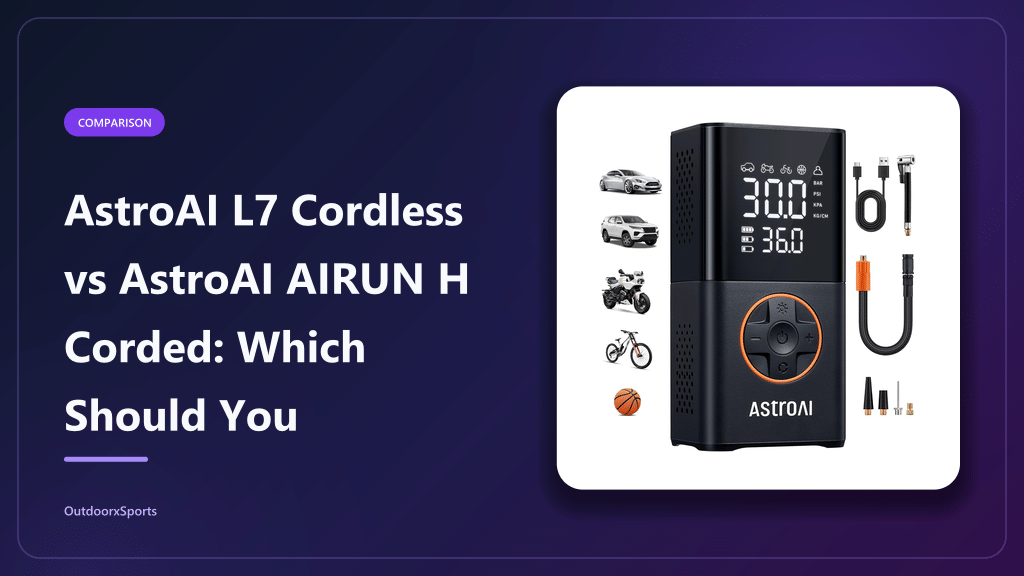
Choosing between the AstroAI L7 Tire Inflator Portable Air vs AstroAI AIRUN H Tire Inflator Portable comes down to one question: do you want a cordless pump that lives in your trunk, or a corded one that never runs out of charge? Both come from the same brand, both share a 35 liter capacity rating, and both handle car tires, bike tires and sports balls.
The short answer: the AstroAI L7 Tire Inflator Portable Air suits drivers who want a battery powered pump they can grab and use anywhere, while the AstroAI AIRUN H Tire Inflator Portable suits anyone who would rather plug into a 12V socket for stronger airflow and a much larger review history. The cards below show the current listings, then we break down where each one earns its keep.


| Product | Details | Rating | Buy |
|---|---|---|---|
|
Editor’s Choice
|
AstroAI L7 Tire Inflator Portable Air |
★★★★☆
4.3/5
|
Check on Amazon |
|
Top Pick
|
AstroAI AIRUN H Tire Inflator Portable |
★★★★⯪
4.5/5
|
Check on Amazon |
At a glance
Two inflators, two design philosophies. The L7 is a cordless tool: a 4000mAh battery, a 15.36 ounce body and a TrueGauge screen that samples pressure 200 times per second. The AIRUN H is a workhorse that draws 120W from your car’s 12V socket and lists 35 L/min of airflow.
That difference shapes everything else. The L7 wins on convenience and storage, while the AIRUN H wins on sustained output and the confidence of 107,448 ratings. Both share a 35 liter capacity rating and a 2 year manufacturer warranty, and both include a needle valve adapter for balls plus a Presta to Schrader adapter for bikes. If you want wider context on this price bracket, our roundup of the best affordable portable tire inflators for 2026 puts both AstroAI models in context.
| Spec | AstroAI L7 Tire Inflator Portable Air | AstroAI AIRUN H Tire Inflator Portable |
|---|---|---|
| Power source | Built-in 4000mAh rechargeable battery | 12V DC car socket with 15A fuse protection |
| Weight and size | 15.36 oz, square ABS plastic body | 800 g, 6.8 x 3.9 x 8.4 in |
| Display | TrueGauge screen, 200 pressure samples per second | Backlit LCD showing live and preset pressure together |
| Inflation claim | Up to 8 tires (195/65R15) from 30 to 36 PSI per charge | 35 L/min airflow from a 120W motor |
| Modes and units | 4+N smart modes including custom; PSI, Bar, kPa, kg/cm² | 3-button preset control; PSI, kPa, Bar, kg/cm² |
| Auto shut-off | Yes, at preset pressure | Yes, at preset pressure |
| In the box | 2 air nozzles, needle valve adapter, Presta to Schrader adapter | 2 air nozzles, needle valve, Presta to Schrader adapter, extension hose, spare fuse |
| Lighting | Flashlight, SOS and strobe modes | One-touch LED flashlight |
| Warranty | 2 year manufacturer | 2 year manufacturer |
| Amazon rating | 4.3/5 from 21,030 reviews; #1 in Wheel & Tire Air | 4.5/5 from 107,448 reviews; #2 in Wheel & Tire Air |
1. AstroAI L7 Tire Inflator Portable Air
The L7 is the newer, cordless side of the AstroAI family. AstroAI fits a 4000mAh battery and a TrueGauge sensor system into a 15.36 ounce body, and offers it in orange, blue, yellow and green. If you want a pump you can carry to a bike rack without hunting for a socket, this is the one.
AstroAI L7 Tire Inflator Portable Air: strengths and weaknesses
The L7 is the model AstroAI sells as a grab-and-go tool. A 4000mAh battery replaces the power cord, a TrueGauge sensor replaces guesswork, and the whole unit weighs 15.36 ounces. In a category where plenty of pumps still need a lighter socket, that combination is the entire pitch.
Auto shut-off is a feature that stops inflation the moment your target pressure is reached, and the L7 leans on it heavily. You pick a mode, nudge the number up or down, press start and step back. The included Presta to Schrader adapter covers narrow road bike valves, and it is worth reading our guide on how to use bike tire inflators safely before you push any tire toward its sidewall maximum.
Where it shines
- Cordless by design. The built-in 4000mAh battery is rated to refill up to 8 tires (195/65R15) from 30 to 36 PSI on a full charge, so there is no cable to run across a wet driveway.
- TrueGauge sampling. AstroAI says the sensor collects pressure data 200 times per second, which is what feeds the live display and triggers the automatic shut-off.
- Presets for almost everything. Four smart modes for car, motorcycle, bicycle and ball, plus a custom mode that lets you set any target you like across PSI, Bar, kPa and kg/cm².
- Genuinely small. At 15.36 ounces it slips into a bike rack bag, a glovebox or a backpack without eating the space you need for other kit.
- Three lighting modes. Flashlight, SOS and strobe turn it into a usable emergency light, not just a pump that sits in the trunk.
Where it falls short
- A flat battery stops everything. There’s no 12V cord in the box, so if the L7 has sat unused for months, you cannot fall back on the car’s socket.
- Plastic shell. The housing is ABS plastic, so it wants a padded spot rather than a toolbox full of wrenches.
- A 150 PSI headline figure. That’s plenty for car, bike and motorcycle tires, but this is not the model AstroAI positions at heavy truck or RV rubber.
- Charging is a habit you have to build. Because the battery powers everything, topping it up needs to become part of your pre-trip routine rather than an afterthought.
Where that leaves the L7: it is the better second pump. Keep it charged in the car and it handles the weekly top-up, the low tire on a cold morning, and the bike that went soft in the garage. It is not the tool for inflating four mud terrain tires in one sitting.
Before you commit to the cordless route, our AstroAI L7 Tire Inflator Portable Air Review takes the same 4000mAh battery and TrueGauge setup through its paces and explains where the slower fills on bigger tires start to matter.
2. AstroAI AIRUN H Tire Inflator Portable
The AIRUN H goes the other way. Instead of a battery it uses a 120W motor fed from your car’s 12V socket through a fused plug, and AstroAI lists 35 liters per minute of airflow. It is the older and far more heavily reviewed product of the two.
AstroAI AIRUN H Tire Inflator Portable: strengths and weaknesses
A 12V DC socket is the round accessory port inside a car that supplies low voltage power, and it is what makes the AIRUN H work. Plug in, set a target, press start. The upside is essentially unlimited runtime while the vehicle is running; the downside is that you are tethered to the car for the whole job.
Airflow, measured in liters per minute, is the volume of air a pump pushes through in a given time, and it is the number that separates corded pumps from battery ones. AstroAI lists 35 L/min from the AIRUN H’s 120W motor, which is the kind of figure battery pumps rarely quote. For a broader look at corded options on the road, there is a useful comparison in this breakdown of the TCCBAC portable air compressor for roadside assistance.
If the cord stays acceptable and you want the full picture on this pump before committing, our dedicated AstroAI AIRUN H Tire Inflator Portable Review works through the same 120W motor and 35 L/min figure in detail, including where it is a skip for cordless buyers.
Where it shines
- Real airflow. A 120W motor rated at 35 L/min is why this is the quicker of the two on a standard car tire, and AstroAI quotes inflation time on a 195/65R15 as its headline.
- A deep review history. 4.5 out of 5 across 107,448 ratings and second place in Wheel & Tire Air is a lot of buyer feedback to lean on.
- Long reach. The 9.84 foot cord plus the included extension hose gives you enough slack to get from a front socket to the rear wheels without moving the car.
- Built for repeat use. A reinforced cylinder, powder metallurgy gears and intelligent thermal management all point at a pump designed to run often rather than once a season.
- A service kit in the box. Two air nozzles, a needle valve for balls, a Presta to Schrader adapter, an extension hose and a spare fuse cover most of what you’ll meet.
Where it falls short
- Tethered to the vehicle. With no internal battery, you cannot inflate a bike tire in the hallway or a wheelbarrow at the far end of the yard.
- Fuse discipline matters. It needs a live 15A socket, and some cars cut accessory power with the ignition off, so a roadside fill may mean starting the engine first.
- Heavier and bulkier. 800 g in a 6.8 x 3.9 x 8.4 inch shell is a different carrying proposition from a sub one pound pump.
- Cord management. Close to ten feet of cable has to go back somewhere tidy, and it rarely cooperates on the first try.
Where that leaves the AIRUN H: it is the pump you buy once and stop thinking about. Keep it in the trunk, feed it from the socket, and it will handle everything from a weekly top-up to a slow leak on a rainy shoulder.
Head-to-head
Which power source suits you better?
The L7 carries its own 4000mAh battery, so the only things you need are a charged pump and a valve stem. No cord to uncoil, no socket to find, no engine to start. The trade-off is that a battery is a consumable part: it ages, it self-discharges, and it needs a charging habit you might not have.
The AIRUN H takes the opposite bet. It pulls 120W through a 15A fused plug from the car’s 12V socket, which means it can run as long as the vehicle can. Some cars cut accessory power when the ignition is off, so a roadside fill may mean starting the engine. Neither approach is better in the abstract; it depends on whether your inflation happens in a driveway or a parking lot.
How fast does each one fill a tire?
PSI is a pressure unit that measures pounds per square inch, and every pump in this comparison works to a preset PSI target. The difference is how quickly they get there. AstroAI lists 35 L/min of airflow for the AIRUN H from its 120W motor, and that is the only flow figure published for either tool.
The L7 answers the speed question differently, with a battery claim instead: up to 8 tires (195/65R15) from 30 to 36 PSI after a full charge. That is a runtime figure, not a flow rate, and it tells you how many tires you can top up rather than how fast one tire fills. For back-to-back work on multiple vehicles, the corded pump has the clearer advantage.
Which display and preset system is easier to use?
Both inflators do the same core job: set a target, press start, let the pump stop itself. The L7 layers on 4+N smart modes, with dedicated car, motorcycle, bicycle and ball presets plus a custom mode, and its TrueGauge sensor collects data 200 times per second.
The AIRUN H keeps it to three buttons and a backlit LCD that shows live and preset pressure side by side, which is genuinely useful at night. Auto shut-off works the same way on both, and both support PSI, Bar, kPa and kg/cm². If you like tailoring settings, the L7 has more to play with; if you want to press one button and get on with your evening, the AIRUN H is the calmer interface.
Which one is easier to live with?
Portability is where the L7 runs away with it. At 15.36 ounces it is lighter than most water bottles, and there is no cable to pack, which matters if the pump lives in a bike bag or a small hatchback with no spare cubby.
The AIRUN H weighs 800 g and measures 6.8 x 3.9 x 8.4 inches, and it brings 9.84 feet of cord along for the ride. That is still a portable tool, and it stows fine in a trunk, but it is not something you toss in a jersey pocket. Cordless wins for anyone who moves the pump between vehicles or carries it on two wheels.
Which one offers better value in 2026?
The L7 sits in the budget bracket and the AIRUN H sits one step above it, so the question is what that extra spend buys. In the AIRUN H’s case you get faster airflow, an extension hose, a spare fuse and a review base of 107,448 ratings instead of 21,030. That is a lot of accumulated evidence for a small premium.
The L7’s counterargument is that a cordless pump is the one you actually use, because nothing stops you reaching for it. It also holds the top spot in Wheel & Tire Air, which suggests plenty of buyers agree. For pure long-term value on a car that gets driven daily in 2026, the corded pump still edges it.
Which one should you buy?
Pick AstroAI L7 Tire Inflator Portable Air if you…
You want a pump you can grab without planning. The L7 suits cyclists, commuters and anyone who keeps gear in a backpack or a small car with limited trunk space. It handles car tires, motorcycle tires, bike tires and balls from a 4000mAh battery, and the custom mode plus four pressure units mean you can dial in a target for almost anything. The one thing you must accept is the charging routine. If you can remember to top it up once a month, it will be ready when you need it.
Pick AstroAI AIRUN H Tire Inflator Portable if you…
Your inflation happens next to a vehicle. Drivers who top up tires weekly, tow a trailer, or simply want the fastest fill available will get more from the AIRUN H. The 35 L/min airflow, the 9.84 foot cord with extension hose, and the spare fuse in the box all point at a tool built for repeated roadside work. It also carries 107,448 ratings at 4.5 out of 5, which is the strongest trust signal in this comparison. Accept the cord and you get the more capable pump.
Other options
If neither format fits, look at a corded 12V pump with a metal cylinder for heavier duty work, or a compact rechargeable pump with a metal barrel if you want battery freedom without the plastic feel. Cyclists who mostly inflate at home should compare a floor pump before buying a portable unit, since a track or floor pump reaches high pressure with far less effort. Our state by state look at the best bike tire inflators in Washington covers what to prioritise for two wheel use.
| You want a pump that lives in a bike bag or a small hatchback with no cord | AstroAI L7 Tire Inflator Portable Air |
| You top up several vehicles a week and want the fastest fill | AstroAI AIRUN H Tire Inflator Portable |
| You want the largest body of buyer feedback before spending | AstroAI AIRUN H Tire Inflator Portable |
| You ride a road or mountain bike and need a Presta friendly pump on the go | AstroAI L7 Tire Inflator Portable Air |
| The pump may sit untouched in a cold trunk for months between uses | AstroAI AIRUN H Tire Inflator Portable |
Frequently asked questions
What is the difference between the AstroAI L7 and the AIRUN H?
The core difference is power. The L7 runs on a built-in 4000mAh battery and weighs 15.36 ounces, so it works anywhere without a cable. The AIRUN H plugs into a car’s 12V socket through a 15A fused plug, uses a 120W motor and lists 35 L/min of airflow. One is a carry-anywhere tool, the other is a vehicle-bound workhorse. Both use auto shut-off, both accept four pressure units and both include a Presta to Schrader adapter.
Does the AstroAI L7 have automatic shut-off?
Yes. Auto shut-off is included on the L7 and works off the TrueGauge sensor, which AstroAI says samples pressure 200 times per second. You preset a target in one of the four smart modes or in custom mode, and the pump stops when it reaches that number. The AIRUN H has the same function driven by its backlit LCD and three-button preset control. On both models it is the feature that lets you walk away instead of watching a gauge.
How fast does the AstroAI AIRUN H inflate a tire?
AstroAI quotes 35 L/min of airflow from the AIRUN H’s 120W motor, which is the only published flow figure for either inflator here. The listing positions it around a standard 195/65R15 car tire going from 30 to 36 PSI. Exact times vary with ambient temperature, tire volume and how far the pressure has to climb, so treat any single number as a guide rather than a promise. The L7 quotes tire count per charge instead of flow rate.
Which AstroAI inflator is better for bike tires?
Both work, and both ship with a Presta to Schrader adapter. Presta is a narrow cycling valve that needs an adapter to fit a Schrader style clamp, so that little part matters more than the pump itself. The L7 is the more practical choice for cyclists because it is cordless and weighs 15.36 ounces. The AIRUN H is fine if you always inflate next to the car, and its higher airflow makes short work of fat tires.
Which AstroAI inflator is more popular?
The AIRUN H. It carries 4.5 out of 5 across 107,448 Amazon ratings and sits second in Wheel & Tire Air and 28th in Automotive. The L7 is newer, with 4.3 out of 5 across 21,030 ratings, but it holds the number one spot in Wheel & Tire Air and second in Automotive. In other words, the AIRUN H has the bigger long-term sample and the L7 has the stronger current sales rank.
Can both inflate car tires?
Yes, and both are designed around that job. The L7 is rated to refill up to 8 car tires (195/65R15) from 30 to 36 PSI per full charge, and its title figure is 150 PSI. The AIRUN H runs from the car’s own 12V supply, so runtime is limited only by the vehicle. Neither is aimed at truck or RV tires. For those you want a heavier corded compressor with a metal cylinder.
Final verdict
Neither pump is a compromise, which is what makes this head-to-head interesting. The AstroAI L7 Tire Inflator Portable Air earns our Editor’s Choice badge because it removes the two biggest reasons people leave a tire pump at home: weight and cables. At 15.36 ounces with a 4000mAh battery, a 200 samples per second TrueGauge sensor, 4+N modes and a three-mode flashlight, it is the one you will actually carry. Rating: 4.2 out of 5, with the battery dependency and plastic housing holding it back.
The AstroAI AIRUN H Tire Inflator Portable takes Top Pick for the opposite reason: it does the hard, repetitive work better. A 120W motor with 35 L/min airflow, a 9.84 foot cord, an extension hose, a spare fuse and 107,448 ratings at 4.5 out of 5 make it the safer recommendation for a daily driver. Rating: 4.4 out of 5, with the cord tether and 800 g weight as its honest drawbacks. In the 2026 Inflator Air vs Tire Inflator question, buy the L7 for portability and the AIRUN H for output.
Affiliate disclosure: This article contains affiliate links. If you buy through them we may earn a commission at no extra cost to you. It does not change which products we recommend.

Welcome to outdoorxsports.com! I’m Russell, your guide to the awesome world of mountain biking. This blog is all about building a community of riders who love to share their passion for the sport. Expect inspiring stories, local trail recommendations, fun challenges, and tips for making the most of your time on two wheels.