
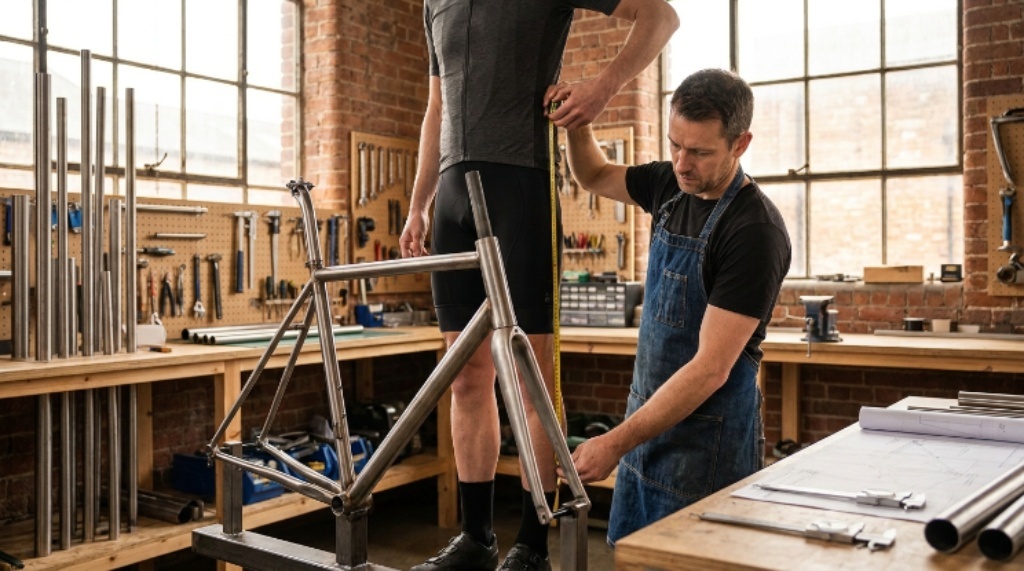
A bicycle can be expensive, lightweight, beautifully engineered—and still not feel right. That is the fundamental reason custom bicycle frames continue to matter in 2026. Modern production bikes have become remarkably sophisticated, with wider tire clearances, more refined geometry, electronic drivetrains, advanced carbon layups, and an impressive range of frame sizes. For many riders, a properly selected stock bike is more than enough.
But “more than enough” is not the same thing as truly personal.
A custom bicycle frame starts with a different question: What does this particular rider need the bike to do?
Instead of choosing a frame size and adapting the rider to it, a custom builder can work backward from the rider’s proportions, position, terrain, handling preferences, luggage requirements, component choices, and long-term goals. That can be especially valuable for riders whose proportions or requirements fall outside conventional size ranges.
The custom-frame market has also evolved. In 2026, custom no longer means only a traditional steel frame made in a small workshop. Builders are combining digital geometry design, modern fitting methods, titanium, advanced carbon construction, 3D-printed components, and increasingly sophisticated manufacturing techniques. At the same time, the handmade-bike world is experimenting with “custom-lite” approaches that preserve some of the advantages of bespoke design without requiring every dimension to be unique.
Key Takeaways
- A custom frame is different from simply getting a professional bike fit or customizing components on a stock frame.
- The biggest reason to go custom is usually fit and function, not simply exclusivity.
- Frame geometry—especially stack, reach, head angle, seat angle, wheelbase, chainstay length, and bottom-bracket drop—has a major influence on how a bicycle fits and handles.
- Steel, titanium, carbon fiber, and aluminum can all make excellent frames, but each involves different compromises in weight, durability, ride characteristics, manufacturing, and cost.
- Customization should begin with how and where you ride, then move to fit, geometry, material, standards, and aesthetics.
- Many riders do not actually need a fully custom frame. A stock frame combined with the right size, cockpit, saddle, crank length, tires, and professional fit can solve most fit problems.
- Custom becomes especially compelling when standard geometry cannot accommodate your body proportions or when you have specific requirements that are difficult to retrofit.
- If you plan to race under UCI rules, equipment compliance needs to be considered before the frame is designed. UCI road equipment rules changed in 2026, including limits affecting fork width and wheel rim height.
What Is a Custom Bicycle Frame?
A custom bicycle frame is a frame designed around a particular rider and a defined set of requirements rather than selected exclusively from a manufacturer’s standard size chart.
That distinction is important.
A “custom bike” can mean several different things. Sometimes a rider buys a production frame and chooses their own wheels, drivetrain, handlebars, paint, and saddle. That’s a customized bike, but the frame geometry remains essentially fixed.
A semi-custom frame may use an existing geometry with selected modifications.
A fully custom frame goes further: the builder develops the frame geometry around the rider’s measurements, riding position, intended use, and desired handling characteristics.
Modern custom builders may review measurements such as stack, reach, saddle position, handlebar position, crank length, wheelbase, chainstay length, head-tube angle, seat-tube angle, bottom-bracket drop, and fork dimensions. The exact process varies by builder and frame material.
The important point is that custom is not simply “a frame that comes in your size.”
Custom Frame vs. Professional Bike Fit: What’s the Difference?
This is one of the biggest information gaps in discussions about custom bikes.
A bike fit changes your position on a bicycle. A custom frame can change the bicycle itself so that your desired position is easier to achieve.
For example, a rider may need a relatively high handlebar and a short reach. A production frame might accommodate that with spacers, a shorter stem, a different handlebar, and saddle adjustments.
If those changes produce a stable, comfortable bike, there may be no reason to build a custom frame.
But imagine a rider with unusually long legs and a comparatively short torso. Or a very tall rider who needs a large amount of saddle height without an excessively long cockpit. Or someone who wants a particular riding position while also requiring unusual tire clearance, rack mounts, or frame-bag attachments.
At that point, changing components may force compromises elsewhere.
That is where custom geometry becomes more meaningful.
Recent discussion among framebuilders has increasingly emphasized this distinction: many riders can achieve an excellent fit on a production frame, while custom geometry is most useful when the standard frame platform cannot deliver the desired fit or functionality.
Why Frame Geometry Matters More Than the Size Label
A frame labeled “56 cm” tells you surprisingly little by itself.
Two bikes with the same nominal size can have noticeably different stack, reach, wheelbase, head angle, seat angle, and chainstay dimensions. That means they can put your body in different positions and respond differently when you steer, climb, descend, or load the bike.
Stack
Stack describes the vertical position of the front end relative to the bottom bracket.
More stack generally allows a taller handlebar position, which can suit endurance riding, long-distance cycling, or riders who prefer a less aggressive posture.
Less stack can support a lower, more aerodynamic position, assuming the rider’s mobility and intended use make that position appropriate.
Reach
Reach describes the horizontal relationship between the bottom bracket and the top of the head-tube area.
It is one of the most useful numbers for comparing how long or short the front end of different frames feels.
Head-Tube Angle and Trail
The head-tube angle interacts with fork offset and wheel size to influence trail, which is closely related to steering behavior.
A geometry designed for fast road racing may prioritize quick, precise responses. A gravel or touring frame may use geometry that emphasizes stability and predictability over rapid steering.
Neither approach is universally better.
Chainstay Length
Chainstay length affects the relationship between the rider, rear wheel, and drivetrain.
Longer chainstays can contribute to stability and create room for larger tires or luggage. Shorter chainstays can contribute to a more compact, lively feel, although the overall handling cannot be predicted from chainstay length alone.
Bottom-Bracket Drop
Bottom-bracket drop influences the bike’s center of gravity and pedal clearance.
Lowering the bottom bracket can contribute to a planted feeling, but clearance must remain appropriate for the intended terrain, crank length, tire size, and riding style.
This is why experienced builders don’t treat geometry numbers as isolated settings. They are part of a system.
Tools such as Bike Insights and other geometry databases make it easier to compare these dimensions across production frames before deciding whether custom geometry is actually necessary.
Choosing the Right Frame Material
Material selection is often presented as a simple question of “Which material is best?”
That is the wrong question.
A better question is: Which material best supports the frame’s intended design and the rider’s priorities?
Steel: Proven, Repairable, and Highly Versatile
Steel remains one of the most established choices for custom framebuilding.
Its appeal goes beyond nostalgia. Steel tubing is available in a wide variety of diameters, wall thicknesses, and profiles, allowing builders to tune a frame for different priorities. It is also comparatively straightforward to fabricate and repair.
A well-designed steel frame can be comfortable, durable, and practical for road, gravel, touring, commuting, or adventure applications.
The tradeoff is weight. A steel frame is generally not the first choice for someone whose overriding goal is minimum mass.
Yet the 2026 handmade-bike scene demonstrates that steel is hardly obsolete. Recent show bikes have combined steel with carbon and 3D-printed titanium components, showing how traditional materials can be incorporated into highly modern designs.
Titanium: The Long-Term Choice
Titanium occupies a particularly interesting position in custom cycling.
It offers high strength, corrosion resistance, and excellent durability, while builders can tune tubing and geometry for different ride characteristics. Its resistance to corrosion also makes it attractive for riders who want a bike that can tolerate years of use with relatively little cosmetic concern.
The drawback is manufacturing complexity. Good titanium framebuilding requires specialized skills and equipment, so quality depends heavily on the builder.
Titanium is therefore less about chasing the lowest possible price and more about building a long-term platform.
Carbon Fiber: Low Weight and Design Freedom
Carbon fiber is fundamentally different from metal tubing.
Instead of relying primarily on tubes with relatively uniform material properties, a carbon frame can use different fiber orientations, layups, tube shapes, and reinforcement strategies to control stiffness, strength, weight, and compliance.
That makes carbon particularly attractive for performance-oriented designs.
Custom carbon frames can also be genuinely bespoke. Tube-to-tube construction, for example, can allow builders to produce custom geometry without relying entirely on a single mass-production mold. Bespoke carbon construction has been used for years by high-end builders.
The downside is that carbon manufacturing is technically demanding, and damage inspection and repair require appropriate expertise.
Aluminum: Light and Practical
Aluminum can deliver a strong combination of low weight, stiffness, and cost.
It is less common than steel or titanium in the traditional custom-frame market, partly because working with aluminum requires specific welding and heat-treatment practices. But it remains a legitimate option for riders who want a lightweight metal frame without moving to carbon.
The material itself does not determine whether a bike will be comfortable. Tube dimensions, geometry, construction quality, tire selection, wheels, cockpit setup, and riding position all matter.
A Practical Material Comparison
| Material | Major strengths | Main tradeoffs | Common custom applications |
| Steel | Versatile, durable, repairable, broad tubing choices | Usually heavier | Touring, gravel, road, adventure |
| Titanium | Corrosion resistance, durability, premium long-term platform | Expensive and demanding to fabricate | Road, gravel, touring, all-road |
| Carbon | Low weight, aerodynamic shaping, tunable stiffness | More complex manufacturing and repair | Racing, road, gravel |
| Aluminum | Light, stiff, comparatively economical | More demanding custom fabrication | Road, gravel, performance builds |
The key lesson is simple: material should follow the design objective—not the other way around.
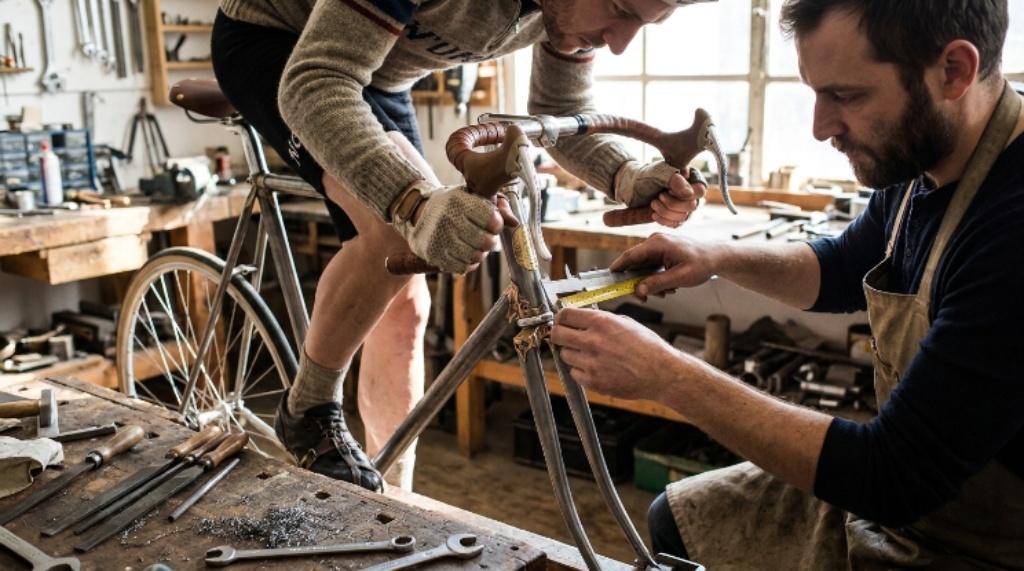
The Custom Frame Design Process
A good custom frame should not begin with a paint color.
It should begin with a conversation.
1. Define the Mission
Tell the builder what the bicycle actually needs to do.
Are you building a road-racing bike?
An endurance machine?
A gravel bike?
A loaded touring bike?
A commuter?
A bikepacking rig?
A one-bike-for-everything platform?
Your answer determines nearly every subsequent decision.
A race frame and a loaded touring frame may both be called “road bikes,” but their ideal geometry, tire clearance, mounting points, stiffness targets, and handling priorities can be dramatically different.
2. Establish Your Fit
A builder needs more than your height.
Relevant information can include inseam, torso and arm proportions, current saddle position, handlebar position, crank length, riding posture, flexibility, and—ideally—the results of a professional bike fit.
A useful approach is to start from a position that has already been tested on the road rather than asking a builder to guess your ideal position from a few body measurements.
3. Translate Fit Into Geometry
The builder then turns that rider information into a frame design.
This is where stack and reach become especially valuable. Instead of relying exclusively on traditional seat-tube sizing, modern frame design can be discussed in terms of the actual position the rider needs.
Geometry is also adjusted for the intended handling.
A fast road bike may need a different balance of wheelbase and steering response than a gravel bike designed for rough descents. A touring frame carrying panniers needs predictable handling under load.
4. Decide on Standards and Components Early
This step is frequently overlooked—and it can create expensive problems.
Before fabrication, decide what the frame needs to accommodate:
- Wheel size and tire width
- Disc or rim brakes
- Thru-axle dimensions
- Bottom-bracket standard
- Electronic or mechanical shifting
- 1x or 2x drivetrain
- Front derailleur requirements
- Seatpost diameter
- Headset standard
- Cable routing
- Fender mounts
- Rack mounts
- Bottle-cage mounts
- Frame-bag attachment points
- Dynamo wiring, if required
- UDH or other modern drivetrain interfaces where applicable
For gravel and adventure bikes especially, tire clearance should be considered as part of the overall design rather than as an afterthought. Current production bikes continue to push toward greater clearance; for example, recent 2026 gravel designs are reaching tire-clearance figures around 50 mm and beyond.
5. Review the Geometry Before Construction
A serious builder should be able to provide a geometry drawing or specification for approval.
Review it carefully.
Do not focus only on whether the numbers “look normal.” Ask whether the geometry achieves the intended position and handling.
If you are not comfortable reading geometry charts, this is an excellent point to involve an experienced fitter.
6. Build, Inspect, Finish, and Assemble
The construction method depends on the material.
Steel and titanium frames may be TIG-welded or use other joining methods. Traditional steel frames may also be brazed.
Carbon frames may use molds, tube-to-tube construction, lugs, or other composite manufacturing techniques.
The important quality-control questions are universal:
- Are the frame dimensions within specification?
- Are the dropouts aligned?
- Are the brake mounts correctly positioned?
- Are the bottom bracket and headset interfaces properly prepared?
- Is the fork compatible with the frame and intended wheel/tire combination?
- Are the cable-routing paths usable?
- Does the finished frame meet the agreed specifications?
A custom frame is expensive precisely because the design is individualized. Documentation and quality control should therefore be part of the process—not an optional extra.
When Is a Custom Frame Actually Worth It?
Custom isn’t automatically better.
That is an important distinction that many marketing articles skip.
A production bike may already offer excellent geometry in your size. If it fits well, handles the way you like, accommodates your preferred tires and equipment, and meets your budget, buying it may be the smarter choice.
Custom becomes more compelling when you have a specific problem that standard frames cannot solve elegantly.
You may be a strong candidate if:
- Your body proportions don’t fit standard geometry well.
- You repeatedly experience fit problems despite professional adjustments.
- You need an unusual combination of stack and reach.
- You want specific tire clearance that stock frames don’t provide.
- You need integrated rack, fender, or luggage mounts.
- You have a very specific riding position.
- You want particular handling characteristics.
- You want a frame designed around a long-term component ecosystem.
- You value craftsmanship and personalization enough to justify the additional cost.
A 2026 perspective is particularly important here: production bikes have improved so much that “I want a better fit” alone is not necessarily enough to justify custom fabrication. A good stock frame plus a carefully configured cockpit can solve many fit requirements.
What Does a Custom Frame Cost?
There is no universal custom-frame price.
Material, country of manufacture, builder reputation, construction method, paint, fittings, fork, component integration, and degree of customization all affect the final number.
The useful way to think about the cost is not simply “custom versus cheap.”
Instead, ask:
What am I paying for that a production frame cannot provide?
A semi-custom program may use an established geometry and reduce design and manufacturing complexity. For example, Ti Cycles currently offers a semi-custom titanium program built around existing geometry data, positioned as a lower-cost and faster alternative to its fully custom design/build service.
That kind of middle ground can be attractive for riders who want personalization without paying for a completely new design.
Custom Frame Trends to Watch in 2026
The custom-bike world is becoming more technologically interesting, not less.
Digital Geometry Is Becoming Standard
Framebuilders increasingly use digital geometry tools and CAD-style workflows to model the frame before construction. That makes it easier to compare dimensions, identify interference issues, and iterate on designs.
3D-Printed Components Are Expanding Possibilities
3D-printed titanium lugs and other components are allowing designers to create shapes and interfaces that would be difficult or expensive to manufacture traditionally. High-end custom and small-batch builders are already using these techniques.
“Custom-Lite” Is Growing
Not every rider needs a completely unique geometry.
The rise of custom-lite and semi-custom approaches reflects a practical truth: many cyclists want the craftsmanship, component choice, paint, and small geometry adjustments associated with custom bikes without commissioning a frame entirely from scratch. The trend was visible at major 2026 handmade-bike events.
Gravel Is Driving More Functional Customization
Modern gravel and all-road bikes increasingly need to balance speed with tire clearance, mounts, stability, and versatility.
That creates a natural role for custom frames. A rider who wants a lightweight road feel but also needs large tires, bags, fenders, unusual gearing, and a particular fit may find that a bespoke frame can combine those requirements more cleanly than a conventional race platform.
What About UCI Racing Rules?
If the bike is intended for sanctioned UCI competition, don’t assume that a beautiful custom design is automatically legal.
The UCI updated equipment requirements for road racing beginning January 1, 2026. Among the changes, the organization introduced maximum internal fork-width limits and a 65 mm maximum rim height for road-race wheels.
The practical takeaway is simple:
Tell your framebuilder before design work begins if the bike will be used in UCI-sanctioned competition.
The builder can then account for applicable equipment regulations rather than discovering a compliance issue after the frame has been manufactured.
How to Choose a Custom Frame Builder
Don’t choose a builder solely because the frames look beautiful on Instagram.
Look for evidence of engineering competence and consistent workmanship.
Ask:
- How does the builder collect fit information?
- Do they work from professional bike-fit data?
- Can they explain their geometry decisions?
- What materials do they specialize in?
- What frame standards do they support?
- How do they verify alignment and dimensions?
- What warranty is provided?
- What happens if the finished frame does not match the approved specification?
- What is the expected production timeline?
- Does the builder have experience with your type of riding?
A good builder should be interested in your riding goals—not just your preferred paint color.
Frequently Asked Questions
Is a custom bicycle frame better than a stock frame?
Not automatically. Modern production bikes offer excellent geometry and fit options. Custom is most valuable when standard frames cannot meet your specific fit, handling, equipment, or functional requirements.
Do I need a professional bike fit before ordering a custom frame?
It is strongly recommended. A professional fit can establish a tested riding position that the framebuilder can then design around. This reduces the risk of building an expensive frame around incorrect assumptions.
Which material is best for a custom frame?
There is no universal winner. Steel is versatile and highly repairable; titanium offers durability and corrosion resistance; carbon provides exceptional opportunities for weight and stiffness tuning; aluminum can provide a lightweight, stiff, cost-conscious metal option.
Is titanium worth the extra money?
It can be, particularly for riders seeking a durable, corrosion-resistant frame intended for long-term ownership. But the value depends on your priorities and budget. A well-designed steel or carbon frame can be a better choice for another rider.
Can a custom frame be lighter than a production bike?
Yes, but “custom” does not automatically mean lighter. Frame weight depends on material, tubing or layup, design requirements, size, strength targets, and manufacturing method. A custom frame designed for durability, large tires, luggage, and mounts may intentionally be heavier than a minimalist race frame.
Can I use a custom frame for gravel riding?
Absolutely. Gravel is one of the applications where custom geometry and features can be particularly useful. Tire clearance, stable handling, luggage mounts, fender compatibility, drivetrain choice, and rider position can all be specified around your intended riding.
How long does a custom frame take to build?
There is no universal lead time. It varies with the builder, material, workload, design complexity, paint, component availability, and shipping. Ask for a current production estimate before paying a deposit.
Is custom worth it for a beginner?
Usually, a beginner should first establish what type of riding they actually enjoy. A quality production bike and professional setup are generally more sensible starting points. Custom becomes more compelling once you understand your riding preferences and have specific requirements that standard bikes cannot meet.
Can I transfer my existing components to a custom frame?
Often, yes—but compatibility must be checked before the frame is designed. Bottom brackets, axles, headset standards, brakes, seatposts, cable routing, drivetrain configuration, and wheel/tire dimensions all need to be considered.
The Bottom Line
The best custom bicycle frame isn’t the one with the most exotic material, the most aggressive geometry, or the highest price tag.
It’s the one where the design decisions make sense together.
Your body determines the fit. Your riding determines the geometry. Your terrain influences tire clearance and handling. Your equipment determines many of the frame’s interfaces. Your priorities determine the material. And your long-term plans determine whether full customization is worth the additional cost and lead time.
That is the real appeal of custom framebuilding.
You’re not simply buying a bicycle that happens to come in your size. You’re working through a design process to create a machine around a particular rider, a particular type of riding, and a particular idea of what a bicycle should feel like.
And in an era when production bikes are already remarkably good, that distinction matters.
Custom isn’t about proving that standard bikes are bad. It’s about eliminating the compromises that matter most to you.

Welcome to outdoorxsports.com! I’m Russell, your guide to the awesome world of mountain biking. This blog is all about building a community of riders who love to share their passion for the sport. Expect inspiring stories, local trail recommendations, fun challenges, and tips for making the most of your time on two wheels.